


Page 35 - All About History - Issue 54-17
P. 35
Why Blame the Kaiser?


        ACCUSATION 2:
        HE RESENTED
        DEMOCRACY


        Wilhelm’s father, Frederick III, had been an
        enthusiastic liberal with plans to revise the
        democratic structures of the empire while his
        grandfather, Wilhelm I, had been a reluctant
        reformer spurred on by a desire to stop Germany
        from descending back into the revolutions it had
        experienced in 1848. Wilhelm II, however, was
        anything but a reformer. Addressing a meeting of
        labourers from the Rhine, he said that “the Reich
        has one ruler and I am he” — a mantra he clearly
        stood by throughout his reign.
          His very first act as kaiser was to surround the
        Neues Palais at Potsdam, where his father had just
        taken his last breath. He had all the gates locked
        while his soldiers ransacked every room looking
        for evidence of a ‘plot’, which involved his mother
        and father attempting to reduce the power of
        the monarchy. Nothing was found — any notes
        that may have incriminated them had already
        been stored safely in Buckingham Palace before
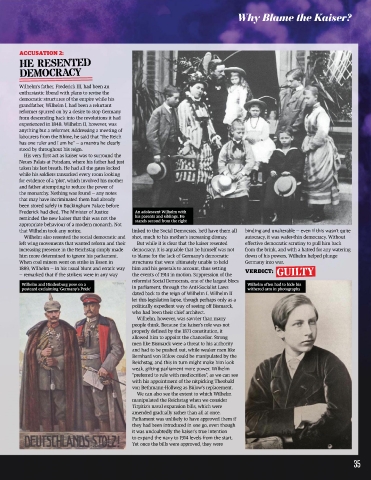
        Frederick had died. The Minister of Justice   An adolescent Wilhelm with
        reminded the new kaiser that this was not the   his parents and siblings. He
                                                stands second from the right
        appropriate behaviour of a modern monarch. Not
        that Wilhelm took any notice.          linked to the Social Democrats, he’d have them all   binding and unalterable — even if this wasn’t quite
          Wilhelm also resented the social democratic and   shot, much to his mother’s increasing dismay.  autocracy, it was wafer-thin democracy. Without
        left wing movements that wanted reform and their   But while it is clear that the kaiser resented   effective democratic scrutiny to pull him back
        increasing presence in the Reichstag simply made   democracy, it is arguable that he himself was not   from the brink, and with a hatred for any watering
        him more determined to ignore his parliament.   to blame for the lack of Germany’s democratic   down of his powers, Wilhelm helped plunge
        When coal miners went on strike in Essen in   structures that were ultimately unable to hold   Germany into war.
        1889, Wilhelm — in his usual blunt and erratic way   him and his generals to account, thus setting   VERDICT:  GUILTY
        — remarked that if the strikers were in any way   the events of 1914 in motion. Suppression of the
                                               reformist Social Democrats, one of the largest blocs
         Wilhelm and Hindenburg pose on a                                               Wilhelm often had to hide his
         postcard exclaiming ‘Germany’s Pride’  in parliament, through the Anti-Socialist Laws   withered arm in photographs
                                               dated back to the reign of Wilhelm I. Wilhelm II
                                               let this legislation lapse, though perhaps only as a
                                               politically expedient way of seeing off Bismarck,
                                               who had been their chief architect.
                                                 Wilhelm, however, was savvier than many
                                               people think. Because the kaiser’s role was not
                                               properly defined by the 1871 constitution, it
                                               allowed him to appoint the chancellor. Strong
                                               men like Bismarck were a threat to his authority
                                               and had to be pushed out, while weaker men like
                                               Bernhard von Bülow could be manipulated by the
                                               Reichstag, and this in turn might make him look
                                               weak, gifting parliament more power. Wilhelm
                                               “preferred to rule with mediocrities”, as we can see
                                               with his appointment of the nitpicking Theobald
                                               von Bethmann-Hollweg as Bülow’s replacement.
                                                 We can also see the extent to which Wilhelm
                                               manipulated the Reichstag when we consider
                                               Tirpitiz’s naval expansion bills, which were
                                               amended gradually rather than all at once.
                                               Parliament was unlikely to have approved them if
                                               they had been introduced in one go, even though
                                               it was undoubtedly the kaiser’s true intention
                                               to expand the navy to 1914 levels from the start.
                                               Yet once the bills were approved, they were

                                                                                                                             35

