


Page 37 - All About History - Issue 54-17
P. 37
Why Blame the Kaiser?


           UNHAPPY FAMILIES                                      Wilhelm’s twisted family tree
                                                                 sowed the seeds of conflict


            EDWARD VII OF BRITAIN       NICHOLAS II OF RUSSIA         GEORGE V OF BRITAIN          QUEEN ALEXANDRA
            Wilhelm’s uncle — ‘Fat Old Wales’,    While ‘Nicky’ had all the power   Wilhelm was glad when his cousin   OF DENMARK
            as the kaiser liked to called him   in Russia that Wilhelm so   George succeeded ‘Fat Old Wales’   Edward VII’s Danish wife, Alexandra,
            — was his biggest rival at Cowes.   craved — ‘autocrat’ was not so   to the British throne — not because   had her own axe to grind with
            Wilhelm once remarked that he   much an aspiration but an official   he had much respect for him, but   Germany. In 1864, Prussian forces
            and Edward were so diametrically   part of his title as ‘Emperor and   because he no doubt considered   captured and annexed the duchies
            opposed that “it was scarcely to    Autocrat of all Russians’ — the two   him a pushover, a “homebody”   of Schleswig and Holstein, resulting
             be expected that anything like   were very different people. Nicholas   as he once said, somebody who   in the loss of 40 per cent of Danish
             a cordial friendship would exist   adored his family and, although he   was unadventurous. Indeed, George   territory. There was a suggestion
            between us.” Edward’s accession   could be tetchy, usually resorted   was an avid stamp collector and   that had Kaiser Frederick III lived
              to the British throne in 1901   to reason. On the eve of war, the   found grand occasions like the state   longer, he would have given Alsace-
             significantly soured relations   cousins exchanged telegrams and   opening of Parliament a “terrible   Lorraine, captured during the
            between England and Germany    Nicholas pleaded with Wilhelm to   ordeal”. George also did what   Franco-Prussian War, back to France
             as Queen Victoria had always   acknowledge the gravitas of the   Wilhelm considered unthinkable:    and perhaps even Schleswig and
             managed to mediate Wilhelm.    situation and reconsider his decision   he allowed the powers of the   Holstein to Denmark as well. At
            The animosity that the kaiser felt    to support Austria-Hungary, knowing   monarchy and the Lords to be   Frederick’s funeral Edward asked
            for his uncle seems to stem from    the casualties it would cause and   gradually conceded to the House   Wilhelm, on his wife’s behalf, about
               his anger and feelings of   foreseeing that soon he may be   of Commons as the Liberals   whether this was true and the kaiser
             abandonment felt towards his   “overwhelmed by the pressure   continued with a radical social and   took great offence. It cemented
            mother, Vicky, who was Edward’s   forced upon me and be forced to   constitutional reform agenda under   his view that Britain should be
            elder sister and close confidante.  take extreme measures.”  Prime Minister Asquith.     considered the enemy.


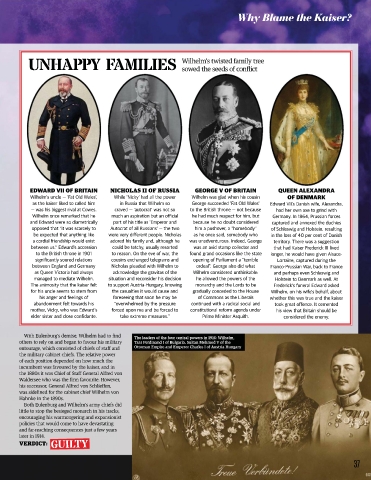
          With Eulenburg’s demise, Wilhelm had to find   The leaders of the four central powers in 1916: Wilhelm,
        others to rely on and began to favour his military   Tsar Ferdinand I of Bulgaria, Sultan Mehmed V of the
        entourage, which consisted of chiefs of staff and   Ottoman Empire and Emperor Charles I of Austria-Hungary
        the military cabinet chiefs. The relative power
        of each position depended on how much the
        incumbent was favoured by the kaiser, and in
        the 1880s it was Chief of Staff General Alfred von
        Waldersee who was the firm favourite. However,
        his successor, General Alfred von Schlieffen,
        was sidelined for the cabinet chief Wilhelm von
        Hahnke in the 1890s.
          Both Eulenburg and Wilhelm’s army chiefs did
        little to stop the besieged monarch in his tracks,
        encouraging his warmongering and expansionist
        policies that would come to have devastating
        and far-reaching consequences just a few years
        later in 1914.
        VERDICT:   GUILTY

                                                                                                                             37

