


Page 38 - All About History - Issue 54-17
P. 38
Why Blame the Kaiser?


        THE KAISER’S CRONIES                                                     ACCUSATION 3:
                                                                                 HE WAS HUNGRY
        The generals and advisors who had Wilhelm’s ear                          FOR WAR


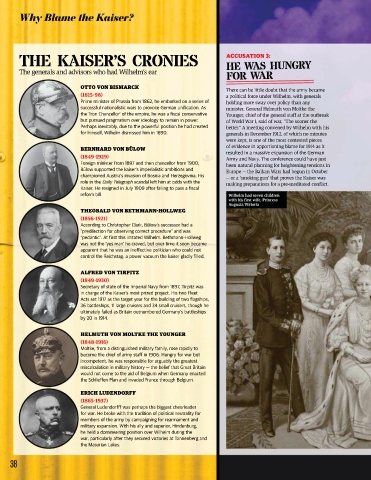
                             OTTO VON BISMARCK
                                                                                 There can be little doubt that the army became
                             (1815-98)                                           a political force under Wilhelm, with generals
                             Prime minister of Prussia from 1862, he embarked on a series of   holding more sway over policy than any
                             successful nationalistic wars to provoke German unification. As   minister. General Helmuth von Moltke the
                             the ‘Iron Chancellor’ of the empire, he was a fiscal conservative   Younger, chief of the general staff at the outbreak
                             but pursued pragmatism over ideology to remain in power.   of World War I, said of war, “The sooner the
                             Perhaps inevitably, due to the powerful position he had created   better.” A meeting convened by Wilhelm with his
                             for himself, Wilhelm dismissed him in 1890.         generals in December 1912, of which no minutes
                                                                                 were kept, is one of the most contested pieces
                                                                                 of evidence in apportioning blame for 1914 as it
                             BERNHARD VON BÜLOW
                                                                                 resulted in a massive expansion of the German
                             (1849-1929)                                         Army and Navy. The conference could have just
                             Foreign minister from 1897 and then chancellor from 1900,   been natural planning for heightening tensions in
                             Bülow supported the kaiser’s imperialistic ambitions and   Europe — the Balkan Wars had begun in October
                             championed Austria’s invasion of Bosnia and Herzegovina. His   — or a ‘smoking gun’ that proves the Kaiser was
                             role in the Daily Telegraph scandal left him at odds with the   making preparations for a pre-meditated conflict.
                             Kaiser. He resigned in July 1909 after failing to pass a fiscal
                             reform bill.                                        Wilhelm had seven children
                                                                                 with his first wife, Princess
                                                                                 Augusta Viktoria
                             THEOBALD VON BETHMANN-HOLLWEG
                             (1856-1921)
                             According to Christopher Clark, Bülow’s successor had a
                             “predilection for observing correct procedure” and was
                             “pedantic”. At first this irritated Wilhelm. Bethmann-Hollweg
                             was not the ‘yes man’ he craved, but over time it soon became
                             apparent that he was an ineffective politician who could not
                             control the Reichstag, a power vacuum the kaiser gladly filled.

                             ALFRED VON TIRPITZ
                             (1849-1930)
                             Secretary of state of the Imperial Navy from 1897, Tirpitz was
                             in charge of the Kaiser’s most prized project. His two Fleet
                             Acts set 1917 as the target year for the building of two flagships,
                             36 battleships, 11 large cruisers and 34 small cruisers, though he
                             ultimately failed as Britain outnumbered Germany’s battleships
                             by 20 in 1914.


                             HELMUTH VON MOLTKE THE YOUNGER
                             (1848-1916)
                             Moltke, from a distinguished military family, rose rapidly to
                             become the chief of army staff in 1906. Hungry for war but
                             incompetent, he was responsible for arguably the greatest
                             miscalculation in military history — the belief that Great Britain
                             would not come to the aid of Belgium when Germany enacted
                             the Schlieffen Plan and invaded France through Belgium.

                             ERICH LUDENDORFF
                             (1865-1937)
                             General Ludendorfff was perhaps the biggest cheerleader
                             for war. He broke with the tradition of political neutrality for
                             members of the army by campaigning for rearmament and
                             military expansion. With his ally and superior, Hindenburg,
                             he held a domineering position over Wilhelm during the
                             war, particularly after they secured victories at Tannenberg and
                             the Masurian Lakes.

     38

