


Page 47 - All About History - Issue 54-17
P. 47
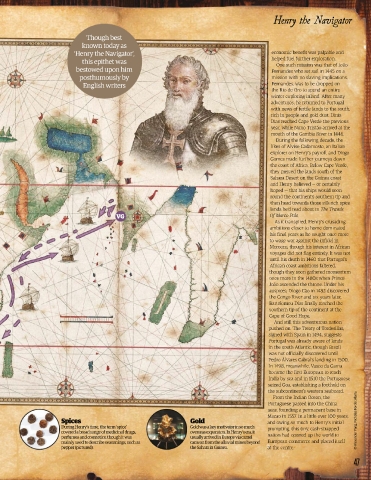
Henry the Navigator
Though best
known today as
‘Henry the Navigator’, economic benefit was palpable and
helped fuel further exploration.
this epithet was
One such mission was that of João
bestowed upon him Fernandes who set sail in 1445 on a
posthumously by mission with no slaving implications.
English writers Fernandes, was to be dropped on
the Rio de Oro to spend an entire
winter exploring inland. After many
adventures, he returned to Portugal
with news of fertile lands to the south,
rich in people and gold dust. Dinis
Dias reached Cape Verde the previous
year, while Nuno Tristão arrived at the
mouth of the Gambia River in 1446.
During the following decade, the
likes of Alvise Cadamosto, an Italian
explorer on Henry’s payroll, and Diogo
Gomes made further journeys down
the coast of Africa. Below Cape Verde,
they pierced the lands south of the
Sahara Desert on the Guinea coast
and Henry believed — or certainly
hoped — that his ships would soon
round the continent’s southern tip and
then head towards those silk-rich spice
lands he’d read about in The Travels
VG Of Marco Polo.
As it transpired, Henry’s crusading
ambitions closer to home dominated
his final years as he sought once more
to wage war against the infidel in
Morocco, though his interest in African
voyages did not flag entirely. It was not
until his death in 1460 that Portugal’s
African coast ambitions faltered,
though they soon gathered momentum
once more in the 1480s when Prince
João ascended the throne. Under his
auspices, Diogo Cão in 1482 discovered
the Congo River and six years later,
Bartolomeu Dias finally reached the
southern tip of the continent at the
Cape of Good Hope.
And still this adventurous nation
pushed on. The Treaty of Tordesillas,
signed with Spain in 1494, suggests
Portugal was already aware of lands
in the south Atlantic, though Brazil
was not officially discovered until
Pedro Álvares Cabral’s landing in 1500.
In 1498, meanwhile, Vasco da Gama
became the first European to reach
India by sea and in 1510 the Portuguese
seized Goa, establishing a foothold on
the subcontinent’s western seaboard.
From the Indian Ocean, the
Portuguese passed into the China
seas, founding a permanent base in
Macao in 1557. In a little over 100 years,
Spices Gold and owing so much to Henry’s initial © Alexander Pang, Nicholas Forder,Alamy
During Henry’s time, the term ‘spice’ Gold was a key motivator in so much prompting, this tiny, cash-strapped
covered a broad range of medicinal drugs, overseas expansion. In Henry’s era, it
perfumes and cosmetics, though it was usually arrived in Europe via camel nation had opened up the world to
mainly used to describe seasonings, such as caravan from the alluvial mines beyond European commerce and placed itself
pepper (pictured). the Sahara in Guinea. at the centre.
47

