


Page 45 - All About History - Issue 54-17
P. 45
Henry the Navigator
further south and they soon found Cape Blanco native tribesmen for interrogation as the prince his complicity. The chronicler Zurara attended the
and explored the great bay that it enclosed. sought further information about the coast and the auction of these slaves in August 1444 and recorded
With papal and royal consent, Henry also deserts that marked its shoreline. both human misery as well as lavish spectacle.
continued his crusading ambitions and his But these missions took a darker turn in 1444 Henry’s involvement with the slave trade has long
chronicler records with gusto the deeds of arms of as one was despatched with a specific and more troubled his biographers. Apologists, such as Zurara,
the Portuguese troops who were set ashore during sinister design. Six ships, organised by Henry’s point to Henry’s desire to convert these people to
the 1440s, though to the modern mind the notion henchman Lancarote da Ilha, sailed with orders to Christianity, while others suggest a validity fostered
of heavily armed and well-trained European troops take slaves from the islands of the Arg guin Bank, b by the Africans’ status as prisoners of war; both the
y
h l
p
f
p
laying into scantily armed fishermen and nomads j just south of Cape Blanco. It was Lancarote who Venetians and Genoese practised sl lavery while the
h
p
appears less than chivalrous. It also became f funded the expedition, rather than the prince, Moors regularl l h
g l ly sold their prisoners into servitude.
p
commonplace for Henry’s men to try and capture but he required Henry’s consent and, therefore, However Henry chose to justify his actions, the
T The caravels of conquest
f
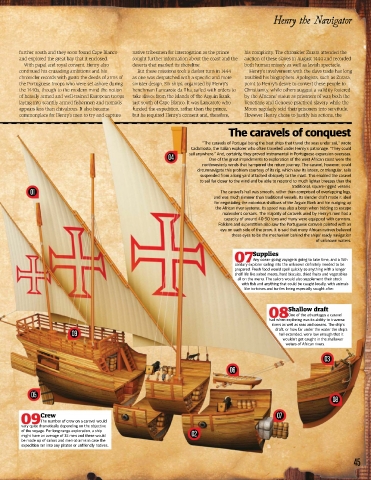
“The caravels of Portugal being the best ships that travel the seas under sail,” wrote
C Cadamosto, the Italian explorer who often travelled under Henry’s patronage. “They could
f
g
y
y
y
04 s sail anywhere.” And, certainly, they proved instrumental in Portuguese expansion overseas.
One of
f the great impediments to exploration of the west African coast were the
f
f
h
h
n northwesterly winds that hampered the return journey. The caravel, however, could
h
j
ly
d h
d
h
y
ld
l h
y
g
g
circumnavig gate this problem courtesy of its rig, which saw its lateen, or triangular, sails
suspended f from a long yard attached obliquely to the mast. This enabled the caravel
t to sail far closer to the wind and be able to respond to much lighter breezes than the
g
f
t traditional, square-rigged vessels.
01 The caravel’s hull was smooth, rather than comprised of f overlapping logs,
and was much slimmer than traditional vessels. Its slender draft made it ideal
f
f for negotiating the notorious shallows of the Arguin Bank and for nudging up
f
the African river sy ystems. Its speed was also a boon when bidding to escape
g
j
y
y
malevolent corsairs. The majority y of caravels used by Henry’s men had a
capacity o ff around 40-50 tons and many were equipped with cannons.
Folklore and superstition also saw the Portug guese caravels painted with an
eye on each side of f the prow. It is said that many African natives believed
f
b
g
b h d h
h
h
h
dy
y
th these eyes to be the mechanism behind the ships’ ready navigation
o of unknown waters.
0 S u pp l n- i e s
S pp i s
A Any ocean-going voyage is going to take time, and a 15th
century explorer sailing into the unknown def finitely needed to be
prepared. Fresh f food would spoil quickly so anything with a longer
f
s shelf life like salted meats, hard biscuits, dried fruits and vegetables
a d
f f
all on the menu. The sailors would also supp
pplement their stock
f
w with fish and anything that could be caught locally, with animals
like tortoises and turtles being especially sought af fter.
8 Sha ll o d a t caravel l
Sha ow draft
One of the advantag
ges a
c
h
g
l
a
h dd when exploring was its ability to traverse
h
b l y
h
h ’s
rivers as we llll as seas and oceans. The ship’s
d
09 draft, or how far under the water the ship ’ ’ss
l
h
gh h
h llll extended, were low enough that it
u
d d
ldn’t get caught in the shallower
would g gh h h ll
waters of African rivers.
03
06
05
08
09 C ewew b c l ld 07
C
r
T The number of crew on a caravel would
d
vary y quite dramatically depending on the objective
d g
h
bj
lly d
,
g
h
o of the voyage. For long-range exploration, a ship 02
y g
g
mig g
m ght have an average of 35 men and these would
b be made up of sailors and men-at-arms in case the
y
e expedition ran into any pirates or unfriendly natives.
y
45 45

