


Page 94 - Time Special Edition Alternative Medicine (January 2020)
P. 94
ALTERNATIVE      MEDICINE  FOOD CURES


                   search indicates that gut microbes adjust to what
                   we eat and react to the air we breathe and illnesses
                   we encounter.
                      Figuring out how these microbial populations
                   respond to stimuli will open whole new treatment
                   paths—and maybe even help us avoid sickness in the
                   first place. Over the span of a decade, the NIH in-
                   vested $170 million in the Human Microbiome Proj-

                   ect, which ended in 2016. Modeled after the Human
                   Genome Project, which sequenced the body’s genes,
                   the Human Micro biome Project sequenced about
                   3,000   bacterial  genomes    from  samples   collected
                   from more than 300 people.


                   Good germs, bad germs

                   Some bugS deServe Their bad repuTaTionS,
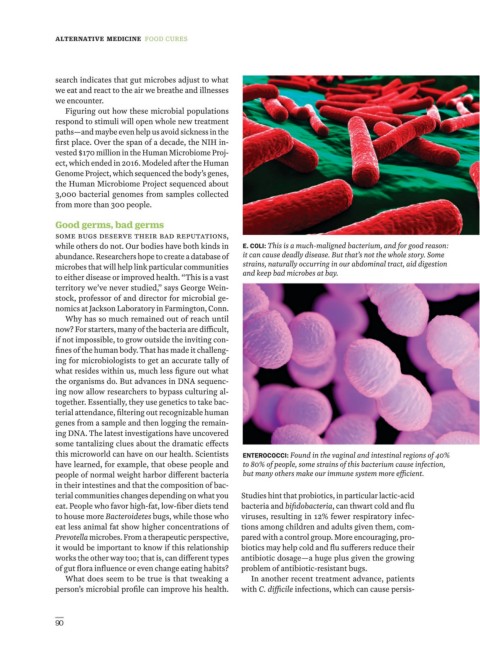
                   while others do not. Our bodies have both kinds in           E. COLI: This is a much-maligned bacterium, and for good reason:
                   abundance. Researchers hope to create a database of          it can cause deadly disease. But that’s not the whole story. Some
                   microbes that will help link particular communities          strains, naturally occurring in our abdominal tract, aid digestion
                                                                                and keep bad microbes at bay.
                   to either disease or improved health. “This is a vast
                   territory we’ve never studied,” says George Wein-
                   stock, professor of and director for microbial ge-
                   nomics at Jackson Laboratory in Farmington, Conn.
                      Why has so much remained out of reach until

                   now? For starters, many of the bacteria are difficult,
                   if not impossible, to grow outside the inviting con-
                   fines of the human body. That has made it challeng-
                   ing for microbiologists to get an accurate tally of
                   what resides within us, much less figure out what
                   the organisms do. But advances in DNA sequenc-

                   ing now allow researchers to bypass culturing al-
                   together. Essentially, they use genetics to take bac-
                   terial attendance, filtering out recognizable human
                   genes from a sample and then logging the remain-
                   ing DNA. The latest investigations have uncovered
                   some tantalizing clues about the dramatic effects
                   this microworld can have on our health. Scientists           ENTEROCOCCI: Found in the vaginal and intestinal regions of 40%
                   have learned, for example, that obese people and             to 80% of people, some strains of this bacterium cause infection,
                   people of normal weight harbor different bacteria            but many others make our immune system more efficient.

                   in their intestines and that the composition of bac-
                   terial communities changes depending on what you             Studies hint that probiotics, in particular lactic-acid
                   eat. People who favor high-fat, low- fiber diets tend        bacteria and bifidobacteria, can thwart cold and flu
                   to house more Bacteroidetes bugs, while those who            viruses, resulting in 12% fewer respiratory infec-
                   eat less animal fat show higher concentrations of            tions among children and adults given them, com-
                   Prevotella microbes. From a therapeutic perspective,         pared with a control group. More encouraging, pro-
                   it would be important to know if this relationship           biotics may help cold and flu sufferers reduce their

                   works the other way too; that is, can different types        antibiotic dosage—a huge plus given the growing
                   of gut flora influ ence or even change eating habits?        problem of antibiotic-resistant bugs.
                      What   does   seem  to  be  true  is  that  tweaking  a      In another recent treatment advance, patients
                   person’s microbial profile can improve his health.           with C. difficile infections, which can cause persis-


                   90

