


Page 95 - Time Special Edition Alternative Medicine (January 2020)
P. 95
“The biggest question in this area has always been,
what’s the best way to deliver the transplant?” says
Kao. The treatment remains experimental and has
not yet received FDA approval, but it is widely con-
sidered very promising and is gaining momentum.
Similarly, doctors at some cancer centers advise
patients to bank stool samples—essentially, a con-
centrated form of their microbiome—before chemo-
therapy, just as they might store blood for transfu-
sions, to replenish what the toxic treatment wipes
out. Early studies show that patients who do this re-
bound quicker from their chemo course than those
who don’t.
Then again, doctors don’t expect fecal trans-
plants to become as common as flu shots. “I think
that in the not-too-distant future we will be able to
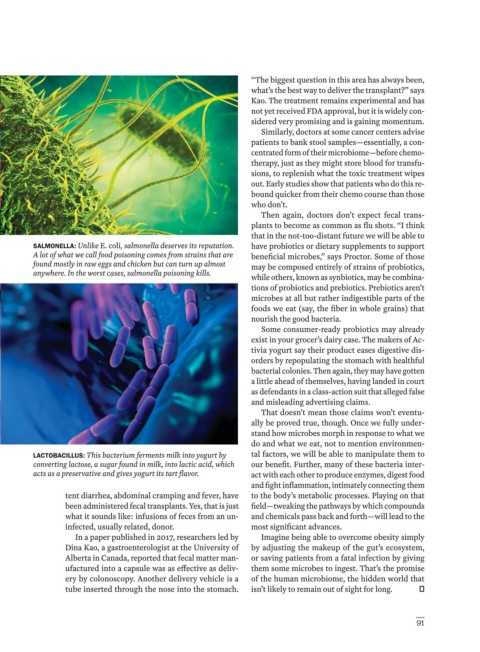
SALMONELLA: Unlike E. coli, salmonella deserves its reputation. have probiotics or dietary supplements to support
A lot of what we call food poisoning comes from strains that are beneficial microbes,” says Proctor. Some of those
found mostly in raw eggs and chicken but can turn up almost may be composed entirely of strains of probiotics,
anywhere. In the worst cases, salmonella poisoning kills.
while others, known as synbiotics, may be combina-
tions of probiotics and prebiotics. Prebiotics aren’t
microbes at all but rather indigestible parts of the
foods we eat (say, the fiber in whole grains) that
nourish the good bacteria.
Some consumer-ready probiotics may already
exist in your grocer’s dairy case. The makers of Ac-
tivia yogurt say their product eases digestive dis-
orders by repopulating the stomach with healthful
bacterial colonies. Then again, they may have gotten
a little ahead of themselves, having landed in court
as defendants in a class-action suit that alleged false
and misleading advertising claims.
That doesn’t mean those claims won’t eventu-
ally be proved true, though. Once we fully under-
stand how microbes morph in response to what we
do and what we eat, not to mention environmen-
LACTOBACILLUS: This bacterium ferments milk into yogurt by tal factors, we will be able to manipulate them to
converting lactose, a sugar found in milk, into lactic acid, which our benefit. Further, many of these bacteria inter-
acts as a preservative and gives yogurt its tart flavor. act with each other to produce enzymes, digest food
and fight inflammation, intimately connecting them
tent diarrhea, abdominal cramping and fever, have to the body’s metabolic processes. Playing on that
been administered fecal transplants. Yes, that is just field—tweaking the pathways by which compounds
what it sounds like: infusions of feces from an un- and chemicals pass back and forth—will lead to the
infected, usually related, donor. most significant advances.
In a paper published in 2017, researchers led by Imagine being able to overcome obesity simply
Dina Kao, a gastroenterologist at the University of by adjusting the makeup of the gut’s ecosystem,
Alberta in Canada, reported that fecal matter man- or saving patients from a fatal infection by giving
ufactured into a capsule was as effective as deliv- them some microbes to ingest. That’s the promise
ery by colonoscopy. Another delivery vehicle is a of the human microbiome, the hidden world that
tube inserted through the nose into the stomach. isn’t likely to remain out of sight for long.
91

