


Page 219 - (DK Eyewitness) Travel Guide 2017 - Alaska
P. 219
SOUTHWEST ALASK A 217
Wildlife of the Pribilof Islands
The biodiversity of the Pribilof Islands is largely due to the Bering Sea, which is rich in
fish, shellfish, seaweed, and plankton, as well as to the island’s range of habitats, which
include sand dunes, tundra, beaches, lagoons, and towering cliffs. Half of the world’s
population of northern fur seals breeds on St. Paul and St. George, while Steller sea lions
breed on Walrus Island and harbor seals on Otter Island. In the summer, the spectacular
cliffs that gird the islands hum with millions of nesting birds. Sea ice that once reached
this far south from the Arctic brought a substantial population of Arctic foxes to the
Pribilofs, while a reindeer herd that was introduced to St. Paul in the early 20th
century still inhabits the interior of the island.
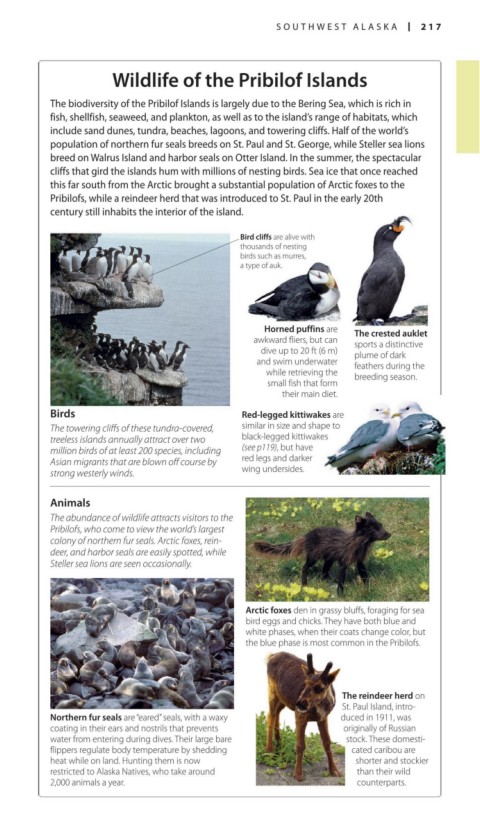
Bird cliffs are alive with
thousands of nesting
birds such as murres,
a type of auk.
Horned puffins are The crested auklet
awkward fliers, but can sports a distinctive
dive up to 20 ft (6 m) plume of dark
and swim under water feathers during the
while retriev ing the breeding season.
small fish that form
their main diet.
Birds Red-legged kittiwakes are
The towering cliffs of these tundra-covered, similar in size and shape to
treeless islands annually attract over two black-legged kittiwakes
million birds of at least 200 species, including (see p119), but have
Asian migrants that are blown off course by red legs and darker
strong westerly winds. wing undersides.
Animals
The abundance of wildlife attracts visitors to the
Pribilofs, who come to view the world’s largest
colony of northern fur seals. Arctic foxes, rein-
deer, and harbor seals are easily spotted, while
Steller sea lions are seen occasionally.
Arctic foxes den in grassy bluffs, foraging for sea
bird eggs and chicks. They have both blue and
white phases, when their coats change color, but
the blue phase is most common in the Pribilofs.
The reindeer herd on
St. Paul Island, intro-
Northern fur seals are “eared” seals, with a waxy duced in 1911, was
coating in their ears and nostrils that prevents originally of Russian
water from entering during dives. Their large bare stock. These domesti-
flippers regulate body temper ature by shedding cated caribou are
heat while on land. Hunting them is now shorter and stockier
restricted to Alaska Natives, who take around than their wild
2,000 animals a year. counterparts.
216-217_EW_Alaska.indd 217 02/05/17 2:32 pm

