


Page 221 - (DK Eyewitness) Travel Guide 2017 - Alaska
P. 221
ALASK A AREA B Y AREA 219
ARCTIC AND
WESTERN ALASKA
Covering nearly two-thirds of Alaska, the vast coastal plains
and wild peaks stretching from the Canadian border to Norton
Sound is a quintessentially Arctic region. While this pristine
wilderness is home to only a few thousand people, Arctic
wildlife is abundant: great herds of caribou live on the
tundra, musk oxen inhabit the North Slope, and millions
of migrating birds flock to the region’s lakes in summer.
Although the winters along the lonely few natural resources. However, in
coastline are not as harsh as those of the the early 20th century, the Nome area
Alaskan Interior, the early Athabaskans experienced a boom, as the beach
chose to continue onward to the forested sands were found to bear gold. Today,
lands to the south, leaving the coast while the attractions of the region are
to the Inupiat and Yup’ik peoples that undeniably spectacular, they are also
arrived later. Remarkably, these hardy universally difficult and expensive to
groups thrived in this barren region. They access. This relative inaccessibility has
subsisted mainly on fish and sea mammals resulted in swathes of untouched
such as seals, sea lions, walrus, and whales, wilderness in parks such as the Arctic
using their skins to make clothing and National Wildlife Refuge and Gates of
their fat to provide heat and light. While the Arctic National Park. Several
long-standing Native traditions are still designated “Wild Rivers” offer rafting
followed to some extent, Native people and fishing, and excellent bird-watching
now lead an increasingly modern way of is available around Nome and Gambell.
life. Alaskans were the last Native people The Dalton Highway is more accessible
to be contacted by Europeans, mainly and follows the Trans-Alaska Pipeline
because they inhabited a wasteland with through spectacular wilderness.
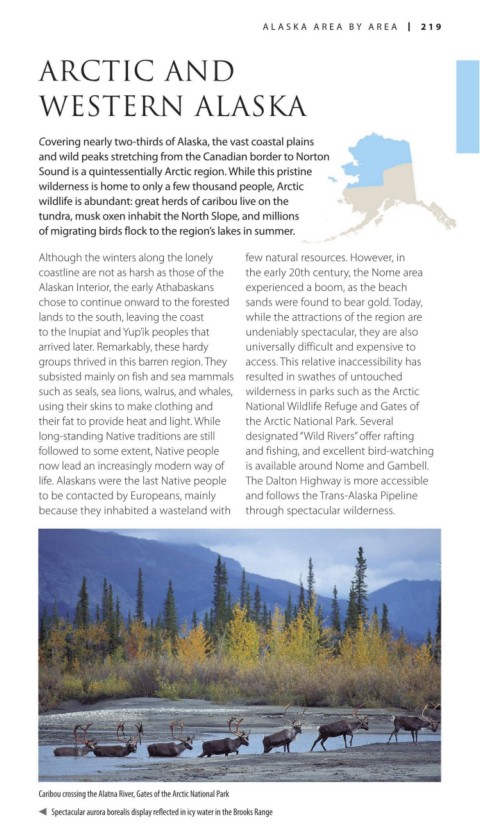
Caribou crossing the Alatna River, Gates of the Arctic National Park
Spectacular aurora borealis display reflected in icy water in the Brooks Range
218-219_EW_Alaska.indd 219 02/05/17 2:32 pm

