


Page 210 - (DK) Help Your Kids with Language Arts
P. 210
208 C OMMUNICA TION SKILLS
Writing to describe SEE ALSO
26–27 Adjectives
DESCRIPTIVE WRITING TELLS THE READER WHAT SOMETHING 40–41 Adverbs
84–85 Idioms, analogies, and figures
OR SOMEONE IS LIKE. of speech
182–183 Picking the right words
Many types of writing use description, from stories to advertisements. 184–185 Making sentences interesting
Descriptive writing uses particular words to paint a vivid image of Writing a narrative 212–213 ›
something in the reader’s head.
The senses • One way to structure a description
When writing to describe, it’s important to appeal to the reader’s senses. is to describe it location by
By describing what something looks, sounds, and feels like, a writer will location, as if moving around
allow the reader to imagine something in detail. Not all of the senses may a scene with a video camera.
be relevant, but try to think about as many as possible.
Barbara walked into the kitchen and was confronted by a rush of
warm air and the smell of something sweet. On the counter was
a triple-layer chocolate cake with fudge icing oozing down the
sides. She eagerly cut a slice and stuffed it into her mouth. The
chocolate sponge was rich and bitter with a slight nutty flavor.
The sugar sprinkles crackled in her mouth and got stuck in her
teeth. Suddenly, the doorbell rang. Barbara jumped, and her cake
splattered across the floor.
Describe what something
looks, feels, smells,
tastes, and sounds like.
REAL W OR L D
Too good to miss
Advertising executives use description to
create tempting pictures in an audience’s
mind to persuade them to buy something.
For example, they might describe hair as
smooth, glossy, and rich to sell a new
shampoo or hair dye. Alternatively,
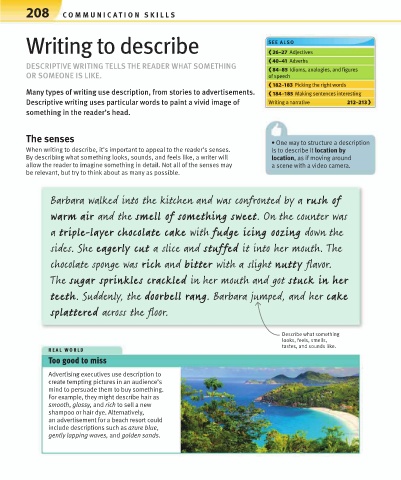
an advertisement for a beach resort could
include descriptions such as azure blue,
gently lapping waves, and golden sands.

