


Page 224 - (DK) Help Your Kids with Language Arts
P. 224
222 C OMMUNICA TION SKILLS
The spoken word SEE ALSO
62–63 Interjections
THE SPOKEN WORD IS DIFFERENT FROM WRITTEN LANGUAGE 86–87 Colloquialisms and slang
88–89 Direct and indirect speech
IN MANY KEY RESPECTS. 94–95 Periods and ellipses
Debates and role plays 224–225
A person’s speech is influenced by various factors, such as where
Writing a speech 226–227
he or she is from and to whom he or she is talking. It’s important Presentation skills 228–229
to consider these factors when writing or analyzing spoken language.
Standard English Good evening. Welcome
Standard English is often considered the “correct” to the nine o’clock news.
form of English, because it is grammatically correct and
does not use any slang. It is usually spoken in a neutral
accent without any regional pronunciation; this is called
General American in North America, Received Pronunciation Standard English uses formal,
in the UK, and General Australian in Australia. unabbreviated vocabulary
Standard English is used in formal situations, and correct grammar.
by public officials, and traditionally by the media.
Dialect and accent
Varieties of spoken English have developed in different
English-speaking countries across the world, and in the regions REAL W OR L D
and communities within them. Each variety has its own colloquial Soap operas
vocabulary and grammatical constructions. These varieties are known
as dialects. An accent is the way in which language is pronounced. The actors in television soap
People use dialectal words and constructions in informal situations. operas set in a particular location
will use the accents from that
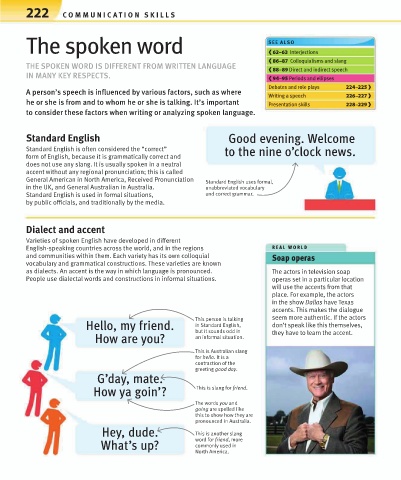
place. For example, the actors
in the show Dallas have Texas
accents. This makes the dialogue
This person is talking seem more authentic. If the actors
Hello, my friend. in Standard English, don’t speak like this themselves,
but it sounds odd in they have to learn the accent.
How are you? an informal situation.
This is Australian slang
for hello. It is a
contraction of the
greeting good day.
G’day, mate.
How ya goin’? This is slang for friend.
The words you and
going are spelled like
this to show how they are
pronounced in Australia.
Hey, dude. This is another slang
word for friend, more
What’s up? commonly used in
North America.

