


Page 225 - (DK) Help Your Kids with Language Arts
P. 225
223
                                                                       THE  SPOKEN  W ORD


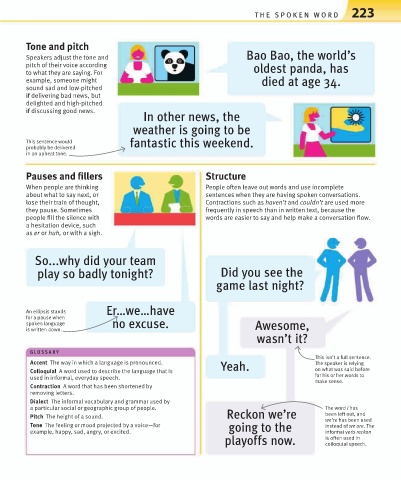
        Tone and pitch
        Speakers adjust the tone and                                 Bao Bao, the world’s
        pitch of their voice according                                 oldest panda, has
        to what they are saying. For
        example, someone might                                           died at age 34.
        sound sad and low-pitched
        if delivering bad news, but
        delighted and high-pitched
        if discussing good news.
                                         In other news, the
                                      weather is going to be
        This sentence would          fantastic this weekend.
        probably be delivered
        in an upbeat tone.


        Pauses and fillers                                 Structure
        When people are thinking                          People often leave out words and use incomplete
        about what to say next, or                        sentences when they are having spoken conversations.
        lose their train of thought,                      Contractions such as haven’t and couldn’t are used more
        they pause. Sometimes                             frequently in speech than in written text, because the
        people fill the silence with                       words are easier to say and help make a conversation flow.
        a hesitation device, such
        as er or huh, or with a sigh.


           So...why did your team
           play so badly tonight?                             Did you see the
                                                             game last night?


                              Er…we…have
        An ellipsis stands
        for a pause when
        spoken language         no excuse.                             Awesome,
        is written down.
                                                                        wasn’t it?

         GLO S S A RY
                                                                                        This isn’t a full sentence.
         Accent  The way in which a language is pronounced.   Yeah.                     The speaker is relying
         Colloquial  A word used to describe the language that is                       on what was said before
                                                                                        for his or her words to
         used in informal, everyday speech.
                                                                                        make sense.
         Contraction  A word that has been shortened by
         removing letters.
         Dialect  The informal vocabulary and grammar used by
         a particular social or geographic group of people.                                The word I has
         Pitch  The height of a sound.                          Reckon we’re               been left out, and
                                                                                           we’re has been used
         Tone  The feeling or mood projected by a voice—for     going to the               instead of we are. The
         example, happy, sad, angry, or excited.                                           informal verb reckon
                                                               playoffs now.               is often used in
                                                                                           colloquial speech.

