


Page 79 - (DK) Help Your Kids with Language Arts
P. 79
77
                                                                   MANAGING MODIFIERS


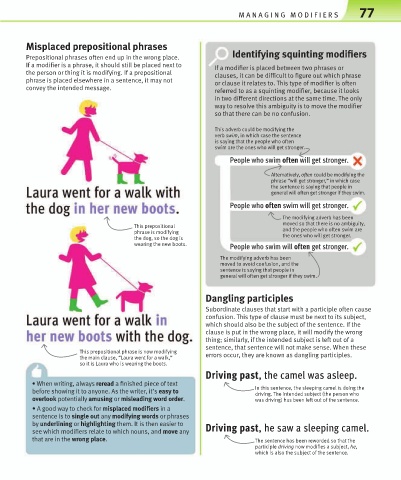
        Misplaced prepositional phrases
        Prepositional phrases often end up in the wrong place.   Identifying squinting modifiers
        If a modifier is a phrase, it should still be placed next to   If a modifier is placed between two phrases or
        the person or thing it is modifying. If a prepositional   clauses, it can be difficult to figure out which phrase
        phrase is placed elsewhere in a sentence, it may not   or clause it relates to. This type of modifier is often
        convey the intended message.
                                                            referred to as a squinting modifier, because it looks
                                                            in two different directions at the same time. The only
                                                            way to resolve this ambiguity is to move the modifier
                                                            so that there can be no confusion.

                                                            This adverb could be modifying the
                                                            verb swim, in which case the sentence
                                                            is saying that the people who often
                                                            swim are the ones who will get stronger.
                                                                People who swim often will get stronger.

                                                                            Alternatively, often could be modifying the
                                                                            phrase “will get stronger,” in which case
                                                                            the sentence is saying that people in
                                                                            general will often get stronger if they swim.
                                                                People who often swim will get stronger.
                                                                               The modifying adverb has been
                                                                               moved so that there is no ambiguity,
                                      This prepositional                       and the people who often swim are
                                      phrase is modifying
                                      the dog, so the dog is                   the ones who will get stronger.
                                      wearing the new boots.
                                                                People who swim will often get stronger.
                                                              The modifying adverb has been
                                                              moved to avoid confusion, and the
                                                              sentence is saying that people in
                                                              general will often get stronger if they swim.


                                                          Dangling participles
                                                          Subordinate clauses that start with a participle often cause
                                                          confusion. This type of clause must be next to its subject,
                                                          which should also be the subject of the sentence. If the
                                                          clause is put in the wrong place, it will modify the wrong
                                                          thing; similarly, if the intended subject is left out of a
                                                          sentence, that sentence will not make sense. When these
                       This prepositional phrase is now modifying
                       the main clause, “Laura went for a walk,”    errors occur, they are known as dangling participles.
                       so it is Laura who is wearing the boots.
                                                          Driving past, the camel was asleep.
          • When writing, always reread a finished piece of text
                                                                       In this sentence, the sleeping camel is doing the
          before showing it to anyone. As the writer, it’s easy to
                                                                       driving. The intended subject (the person who
          overlook potentially amusing or misleading word order.       was driving) has been left out of the sentence.
          • A good way to check for misplaced modifiers in a
          sentence is to single out any modifying words or phrases
          by underlining or highlighting them. It is then easier to
          see which modifiers relate to which nouns, and move any   Driving past, he saw a sleeping camel.
          that are in the wrong place.                                 The sentence has been reworded so that the
                                                                       participle driving now modifies a subject, he,
                                                                       which is also the subject of the sentence.

