


Page 80 - (DK) Help Your Kids with Language Arts
P. 80
78 GRAMMAR
Commonly SEE ALSO
26–27 Adjectives
misused words 34–35 Pronouns
40–41 Adverbs
48–49 Auxiliary verbs
Relative clauses 82–83
SOME GRAMMATICAL ERRORS OCCUR FREQUENTLY.
Idioms, analogies,
and figures of speech 84–85
It’s common to make grammatical mistakes when speaking,
Apostrophes 104–105
but when these mistakes are transferred to writing, the meaning Confusing words 168–171
of a sentence is often affected. Most of these problems result
from confusion between two words.
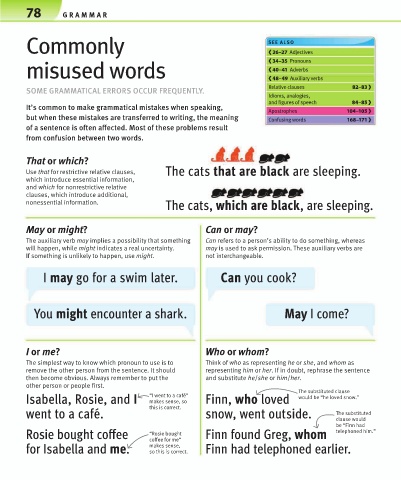
That or which?
Use that for restrictive relative clauses, The cats that are black are sleeping.
which introduce essential information,
and which for nonrestrictive relative
clauses, which introduce additional,
nonessential information. The cats, which are black, are sleeping.
May or might? Can or may?
The auxiliary verb may implies a possibility that something Can refers to a person’s ability to do something, whereas
will happen, while might indicates a real uncertainty. may is used to ask permission. These auxiliary verbs are
If something is unlikely to happen, use might. not interchangeable.
I may go for a swim later. Can you cook?
You might encounter a shark. May I come?
I or me? Who or whom?
The simplest way to know which pronoun to use is to Think of who as representing he or she, and whom as
remove the other person from the sentence. It should representing him or her. If in doubt, rephrase the sentence
then become obvious. Always remember to put the and substitute he/she or him/her.
other person or people first.
The substituted clause
Isabella, Rosie, and I “I went to a café” Finn, who loved would be “he loved snow.”
makes sense, so
this is correct.
went to a café. snow, went outside. The substituted
clause would
be “Finn had
Rosie bought coffee “Rosie bought Finn found Greg, whom telephoned him.”
coffee for me”
for Isabella and me. makes sense, Finn had telephoned earlier.
so this is correct.

