


Page 84 - (DK) Help Your Kids with Language Arts
P. 84
82 GRAMMAR
Relative clauses SEE ALSO
34–35 Pronouns
ALSO KNOWN AS ADJECTIVE CLAUSES, RELATIVE CLAUSES 64–65 Phrases
66–67 Clauses
MODIFY NOUNS. 72–73 Complex sentences
Relative clauses add information to a sentence using the relative 74–75 Using clauses correctly
76–77 Managing modifiers
pronouns who, whom, whose, that, and which. Restrictive
Commas 96–99
relative clauses add essential details, while nonrestrictive
clauses add nonessential details.
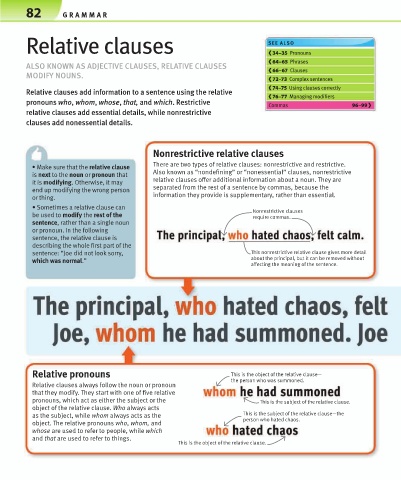
Nonrestrictive relative clauses
• Make sure that the relative clause There are two types of relative clauses: nonrestrictive and restrictive.
is next to the noun or pronoun that Also known as “nondefining” or “nonessential” clauses, nonrestrictive
it is modifying. Otherwise, it may relative clauses offer additional information about a noun. They are
end up modifying the wrong person separated from the rest of a sentence by commas, because the
or thing. information they provide is supplementary, rather than essential.
• Sometimes a relative clause can
Nonrestrictive clauses
be used to modify the rest of the require commas.
sentence, rather than a single noun
or pronoun. In the following
sentence, the relative clause is
describing the whole first part of the
sentence: “Joe did not look sorry, This nonrestrictive relative clause gives more detail
which was normal.” about the principal, but it can be removed without
affecting the meaning of the sentence.
Relative pronouns This is the object of the relative clause—
the person who was summoned.
Relative clauses always follow the noun or pronoun
that they modify. They start with one of five relative
pronouns, which act as either the subject or the This is the subject of the relative clause.
object of the relative clause. Who always acts
as the subject, while whom always acts as the This is the subject of the relative clause—the
person who hated chaos.
object. The relative pronouns who, whom, and
whose are used to refer to people, while which
and that are used to refer to things.
This is the object of the relative clause.

