


Page 81 - (DK) Help Your Kids with Language Arts
P. 81
79
                                                           C OMMONLY  MISUS ED  W ORD S


        Whether or if?                                    Fewer or less?
        Whether does not mean the same thing as if.       Fewer is used for things that can be counted, while
        Whether is used in sentences where there are two   less is used for hypothetical quantities—things that
        or more alternatives, while if can only be used when   cannot be counted.
        there are no alternatives.
                                                          I got fewer than ten
        She couldn’t decide whether                       birthday presents this year.

        to run or hide.
                                                          I have less work to do than he has.
        She doesn’t know if

        anything will happen.                             Bring or take?
                                                          If an object is being moved toward the subject, the
                                                          verb bring should be used. If it is being moved away,
                                                          the verb take should be used.
        Its or it’s?
        Use the possessive determiner its when describing    Should I bring a book to read?
        a thing that belongs to something, and the contraction
        it’s to represent it is.


                                                             You can take one of my books.


              It’s back!              its back
                                                          Good or well?
                                                          Good is an adjective, so it is used to describe nouns.
                                                          Well is mostly used as an adverb to describe verbs,
        Could have or could of?                           adjectives, or other adverbs. However, it can also be used
        In speech, the contracted form of could have, could’ve,   as an adjective to mean “healthy.” Good does not mean
        is often mistakenly interpreted as could of. Could of is   “healthy,” so it shouldn’t be used in that sense.
        wrong and should never be used.
                                                          A good chef eats well, so stays well.
               You could have told me!
                                                                  This adjective    This adverb is  This adjective
                                                                  is describing    describing the  means
                                                                  the noun chef.   verb eats.  “healthy.”

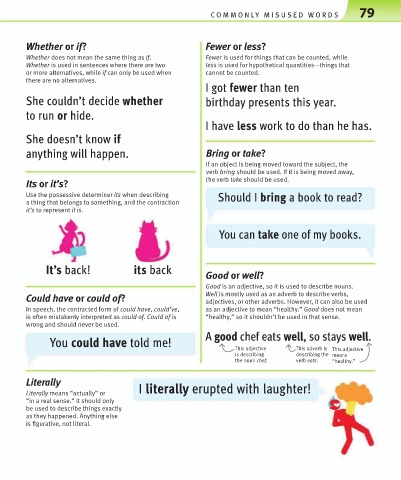
        Literally
        Literally means “actually” or   I literally erupted with laughter!
        “in a real sense.” It should only
        be used to describe things exactly
        as they happened. Anything else
        is figurative, not literal.

