


Page 90 - (DK) Help Your Kids with Language Arts
P. 90
88 GRAMMAR
Direct and SEE ALSO
22–23 Nouns
indirect speech 34–35 Pronouns
36–37 Number and gender
38–39 Verbs
THERE ARE TWO WAYS OF REPRESENTING SPEECH IN WRITING. 40–41 Adverbs
42–43 Simple tenses
Quotation marks 108–109
When a person’s exact words are reproduced in writing within
Writing a narrative 212–213
quotation marks, this is known as direct speech. When a person’s
speech is reported, using neither the exact words nor quotation marks,
it is called indirect or reported speech.
Direct speech
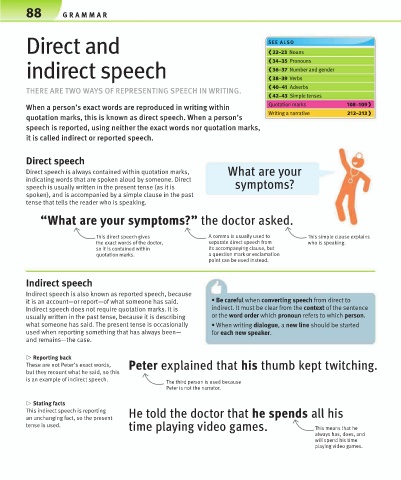
Direct speech is always contained within quotation marks, What are your
indicating words that are spoken aloud by someone. Direct
speech is usually written in the present tense (as it is symptoms?
spoken), and is accompanied by a simple clause in the past
tense that tells the reader who is speaking.
“What are your symptoms?” the doctor asked.
This direct speech gives A comma is usually used to This simple clause explains
the exact words of the doctor, separate direct speech from who is speaking.
so it is contained within its accompanying clause, but
quotation marks. a question mark or exclamation
point can be used instead.
Indirect speech
Indirect speech is also known as reported speech, because
it is an account—or report—of what someone has said. • Be careful when converting speech from direct to
Indirect speech does not require quotation marks. It is indirect. It must be clear from the context of the sentence
usually written in the past tense, because it is describing or the word order which pronoun refers to which person.
what someone has said. The present tense is occasionally • When writing dialogue, a new line should be started
used when reporting something that has always been— for each new speaker.
and remains—the case.
▷ Reporting back
These are not Peter’s exact words, Peter explained that his thumb kept twitching.
but they recount what he said, so this
is an example of indirect speech.
The third person is used because
Peter is not the narrator.
▷ Stating facts
This indirect speech is reporting He told the doctor that he spends all his
an unchanging fact, so the present
time playing video games. This means that he
tense is used.
always has, does, and
will spend his time
playing video games.

