


Page 88 - (DK) Help Your Kids with Language Arts
P. 88
86 GRAMMAR
Colloquialisms and slang SEE ALSO
12–13 Spoken and written language
COLLOQUIALISMS AND SLANG ARE FORMS OF INFORMAL 14–15 English around the world
84–85 Idioms, analogies,
SPOKEN LANGUAGE. and figures of speech
Genre, purpose, and audience 190–191
Colloquialisms are words or phrases that are used in ordinary, Newspaper articles 198–199
informal speech. Slang is even less formal, and is often only The spoken word 222–223
recognized by the members of a particular group. Slang includes Writing a speech 226–227
words or phrases that may be considered taboo.
Some slang terms are
Colloquialisms used so often that they
English speakers use a variety of Colloquialisms are an important part become universal—the
informal words and phrases that of relaxed conversation (known as
differ from region to region but are colloquial speech), but they should slang word cool, meaning
recognized by most native speakers. not be used in formal speech or “fashionable” or “great,”
These words and phrases are called writing. Most colloquialisms are
colloquialisms, which stems from labeled in dictionaries as “informal” is one example.
the Latin word for “conversation.” or with the abbreviation “colloq.”
fella scratch
dude fellow loot dough REAL W OR L D
Rhyming slang
chap guy greenbacks
Rhyming slang, also known as
geezer bread Cockney rhyming slang, originated
in the East End of London in the
gent moola nineteenth century. It is formed
buddy bones by replacing a common word with
a phrase that rhymes with it. Often,
the rhyming part of this phrase is
man money then removed, so the resulting
slang term bears little or no
resemblance to the original
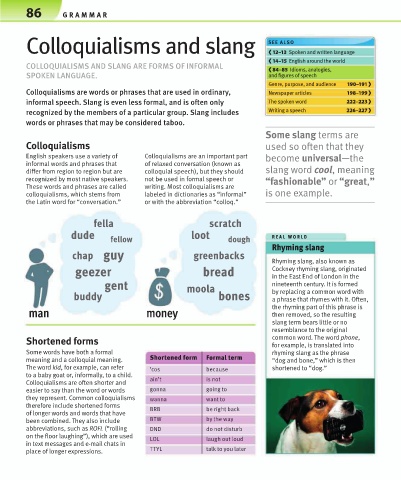
Shortened forms common word. The word phone,
for example, is translated into
Some words have both a formal rhyming slang as the phrase
meaning and a colloquial meaning. Shortened form Formal term “dog and bone,” which is then
The word kid, for example, can refer ’cos because shortened to “dog.”
to a baby goat or, informally, to a child.
Colloquialisms are often shorter and ain’t is not
easier to say than the word or words gonna going to
they represent. Common colloquialisms wanna want to
therefore include shortened forms BRB be right back
of longer words and words that have
been combined. They also include BTW by the way
abbreviations, such as ROFL (“rolling DND do not disturb
on the floor laughing”), which are used LOL laugh out loud
in text messages and e-mail chats in
TTYL talk to you later
place of longer expressions.

