


Page 85 - (DK) Help Your Kids with Language Arts
P. 85
83
                                                                       RELA TIVE  CLA US E S


                 Identifying when a pronoun can be omitted
                                                                            • Although whom is grammatically
           Sometimes a relative pronoun can be omitted                      correct, who is almost always used
           from a relative clause without affecting the sense                instead in everyday English.
           of a sentence. This only works if the pronoun
           is the object of the clause—the person or thing
           receiving the action.                  restrictive relative clause  GLO S S A RY
                                                                           Clause  A grammatical unit that contains
                                                                           a subject and a verb. Sentences are
                                                                           made up of one or more clauses.
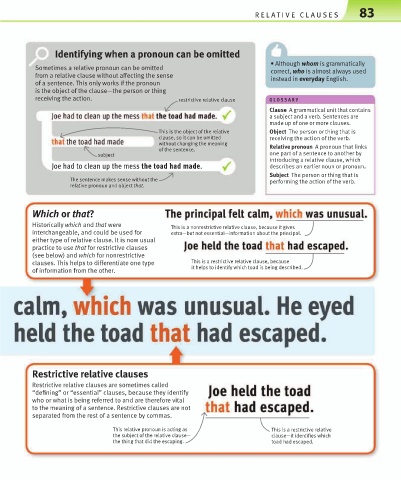
                                             This is the object of the relative   Object  The person or thing that is
                                             clause, so it can be omitted   receiving the action of the verb.
                                             without changing the meaning
                                             of the sentence.              Relative pronoun  A pronoun that links
                            subject                                        one part of a sentence to another by
                                                                           introducing a relative clause, which
               Joe had to clean up the mess the toad had made.             describes an earlier noun or pronoun.
                                                                           Subject  The person or thing that is
                    The sentence makes sense without the                   performing the action of the verb.
                    relative pronoun and object that.


          Which or that?
          Historically which and that were
                                                This is a nonrestrictive relative clause, because it gives
          interchangeable, and could be used for   extra—but not essential—information about the principal.
          either type of relative clause. It is now usual
          practice to use that for restrictive clauses
          (see below) and which for nonrestrictive
          clauses. This helps to differentiate one type   This is a restrictive relative clause, because
                                                      it helps to identify which toad is being described.
          of information from the other.


          Restrictive relative clauses
          Restrictive relative clauses are sometimes called
          “defining” or “essential” clauses, because they identify
          who or what is being referred to and are therefore vital
          to the meaning of a sentence. Restrictive clauses are not
          separated from the rest of a sentence by commas.

                                This relative pronoun is acting as          This is a restrictive relative
                                the subject of the relative clause—         clause—it identifies which
                                the thing that did the escaping.            toad had escaped.

