


Page 162 - (DK) Ocean - The Definitive Visual Guide
P. 162
160     SHALLOW SEAS


                  PACIFIC OCEAN WEST         species concentrated in a few square   PACIFIC OCEAN WEST  In 1988, the Philippines government
                                             kilometres. The reef also contains the                     intervened, declaring the area a
               Shiraho Reef                  world’s largest colony of rare Blue   Tubbataha Reefs      National Marine Park, and since 1993
                                             Ridge Coral (Heliopora coerulea). For                      it has also been a UNESCO World
                              TYPE  Fringing reef  decades, environmentalists battled    TYPE  Atolls   Heritage Site. The condition of the
                              AREA  10 square km    to save the reef from the building of    AREA  330 square km   Tubbataha reefs has much improved,
                              (4 square miles)  a new airport for Ishigaki. A proposal   (130 square miles)  due to the enforcement of measures
                              CONDITION Reasonable;   to construct the airport on top of the   CONDITION  Good;   such as a prohibition on fishing and a
                              damaged in parts by   reef was dropped, but concern remains   recovering from coral   ban on boats anchoring on the reefs
                              bleaching in 1998, 2007  now that it has been built on land, as   bleaching in 2010  (visiting craft must use mooring buoys).
               LOCATION  Southeast coast of Ishigaki Island, at the   discharge of excavated soil into the   LOCATION  Central Sulu Sea, between the Philippines   A setback occurred in January 2013
               southwestern extremity of Japanese archipelago              and northern Borneo
                                             reef is likely to have an adverse effect.                  when a US Navy minesweeper ran
                                                                                                        aground on the reef, damaging over
               Shiraho Reef, off Ishigaki Island, part   BLUE RIDGE CORAL  The Tubbataha Reefs lie around two   2,000 square m (21,500 square ft).
               of the Japanese archipelago, came to   Despite its name, the colour of this coral    atolls in the centre of the Sulu Sea and
               notice in the 1980s as an outstanding   varies from violet through blue, turquoise,    are famous for the many large pelagic
               example of biodiversity, with some   and green to yellow-brown. Its branching   (open ocean) marine animals attracted
               120 species of coral and 300 fish   vertical plates can form massive colonies.  to them – such as sharks, Manta Rays,
                                                                           turtles, and barracuda. The steeply
                                                                           shelving reefs here are also rich in
                                                                           smaller life, including many species
                                                                           of crustaceans, colourful nudibranchs
                                                                           (sea slugs), and more than 350 species
                                                                           of stony and soft coral.
                                                                             In the early 1990s, the Tubbataha
                                                                           Reefs were rated by scuba divers
                                                                           among the top ten dive sites in the
                                                                           world. However, during the 1980s
                                                                           they suffered considerable damage
                                                                           from destructive fishing practices and
                                                                           the establishment of a seaweed farm.
                                                                           CORAL DROP-OFF
                                                                           In this photograph of a steeply shelving
                                                                           reef slope, several species of soft coral
                                                                           are visible, together with a shoal of
                                                                           Longfin Bannerfish.


                  PACIFIC OCEAN WEST         Nusa Tenggara is a chain of around    indicate an extremely high diversity of   Humphead Parrotfish, and various
                                             500 coral-fringed islands in southern   marine life in this region. For example,   species of octopuses and nudibranchs
               Nusa Tenggara                 Indonesia. The northern islands are   a single large reef can contain more   (sea slugs). Major threats to the reefs
                                             volcanic in origin, while the southern   than 1,200 species of fish (more than   in Nusa Tenggara include pollution
                              TYPE  Fringing reefs,   islands consist mainly of uplifted coral   in all the seas in Europe combined),   from land-based sources, removal of
                              barrier reefs
                                             limestone. Many of the reefs have   and 500 different species of reef-  fish for the aquarium trade, and reef
                              AREA  5,000 square km   been only rarely explored. However,   building coral. Common animals here   destruction by blast fishing. Coral
                              (2,000 square miles)
                                             what surveys have been carried out   include Eagle Rays, Manta Rays,   bleaching affected some reefs in 2010.
                              CONDITION  Damaged by
                              fishing practices
               LOCATION  Southern Indonesia, from Lombok in the
               west to Timor in the east


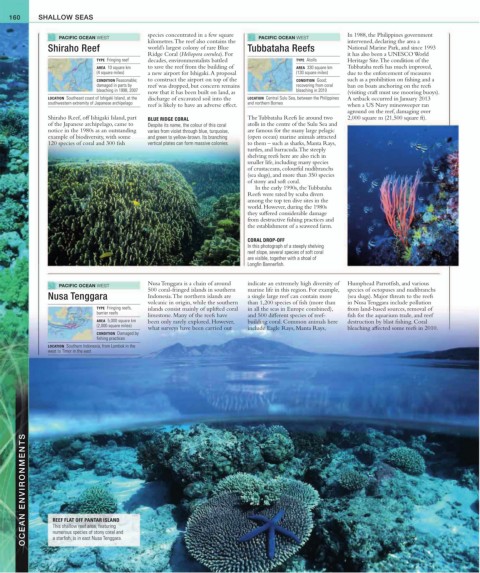
        OCEAN ENVIRONMENTS  REEF FLAT OFF PANTAR ISLAND


                 This shallow reef area, featuring
                 numerous species of stony coral and
                 a starfish, is in east Nusa Tenggara.

