


Page 166 - (DK) Ocean - The Definitive Visual Guide
P. 166
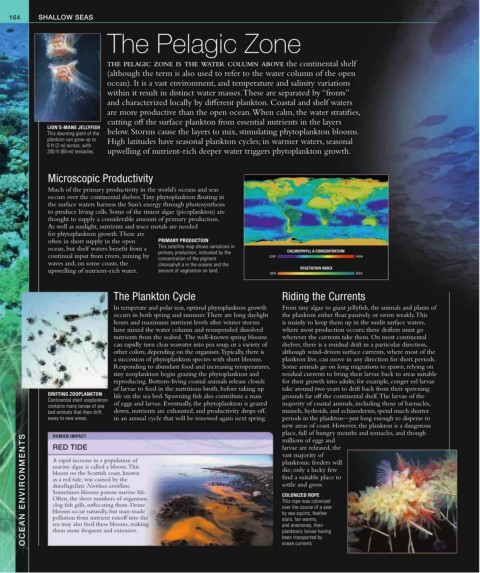
164     SHALLOW SEAS


                                 The Pelagic Zone


                                 THE PELAGIC ZONE IS THE WATER COLUMN ABOVE the continental shelf
                                 (although the term is also used to refer to the water column of the open
                                 ocean). It is a vast environment, and temperature and salinity variations
                                 within it result in distinct water masses. These are separated by “fronts”
                                 and characterized locally by different plankton. Coastal and shelf waters
                                 are more productive than the open ocean. When calm, the water stratifies,
                                 cutting off the surface plankton from essential nutrients in the layers
               LION’S-MANE JELLYFISH
               This daunting giant of the   below. Storms cause the layers to mix, stimulating phytoplankton blooms.
               plankton can grow up to    High latitudes have seasonal plankton cycles; in warmer waters, seasonal
               6 ft (2 m) across, with
               200-ft (60-m) tentacles.  upwelling of nutrient-rich deeper water triggers phytoplankton growth.


               Microscopic Productivity

               Much of the primary productivity in the world’s oceans and seas
               occurs over the continental shelves. Tiny phytoplankton floating in
               the surface waters harness the Sun’s energy through photosynthesis
               to produce living cells. Some of the tiniest algae (picoplankton) are
               thought to supply a considerable amount of primary production.
               As well as sunlight, nutrients and trace metals are needed
               for phytoplankton growth. These are
               often in short supply in the open   PRIMARY PRODUCTION
               ocean, but shelf waters benefit from a   This satellite map shows variations in
                                                primary production, indicated by the   CHLOROPHYLL A CONCENTRATION
               continual input from rivers, mixing by                            LOW                       HIGH
                                                concentration of the pigment
               waves and, on some coasts, the   chlorophyll a in the oceans and the
               upswelling of nutrient-rich water.    amount of vegetation on land.         VEGETATION INDEX
                                                                                 MIN                       MAX
                                   The Plankton Cycle                                Riding the Currents

                                   In temperate and polar seas, optimal phytoplankton growth   From tiny algae to giant jellyfish, the animals and plants of
                                   occurs in both spring and summer. There are long daylight   the plankton either float passively or swim weakly. This
                                   hours and maximum nutrient levels after winter storms   is mainly to keep them up in the sunlit surface waters,
                                   have mixed the water column and resuspended dissolved   where most production occurs; these drifters must go
                                   nutrients from the seabed.  The well-known spring blooms   wherever the currents take them. On most continental
                                   can rapidly turn clear seawater into pea soup, or a variety of   shelves, there is a residual drift in a particular direction,
                                   other colors, depending on the organism. Typically, there is    although wind-driven surface currents, where most of the
                                   a succession of phytoplankton species with short blooms.   plankton live, can move in any direction for short periods.
                                   Responding to abundant food and increasing temperatures,   Some animals go on long migrations to spawn, relying on
                                   tiny zooplankton begin grazing the phytoplankton and   residual currents to bring their larvae back to areas suitable
                                   reproducing. Bottom-living coastal animals release clouds    for their growth into adults; for example, conger eel larvae
                                   of larvae to feed in the nutritious broth, before taking up   take around two years to drift back from their spawning
               DRIFTING ZOOPLANKTON  life on the sea bed. Spawning fish also contribute a mass    grounds far off the continental shelf. The larvae of the
               Continental shelf zooplankton
               contains many larvae of sea   of eggs and larvae. Eventually, the phytoplankton is grazed   majority of coastal animals, including those of barnacles,
               bed animals that then drift    down, nutrients are exhausted, and productivity drops off,    mussels, hydroids, and echinoderms, spend much shorter
               away to new areas.   in an annual cycle that will be renewed again next spring.   periods in the plankton—just long enough to disperse to
                                                                                     new areas of coast. However, the plankton is a dangerous
                                                                                     place, full of hungry mouths and tentacles, and though
        OCEAN ENVIRONMENTS   A rapid increase in a population of                     planktonic feeders will
                 HUMAN IMPACT
                                                                                     millions of eggs and
                 RED TIDE
                                                                                     larvae are released, the
                                                                                     vast majority of
                 marine algae is called a bloom. This
                                                                                     die; only a lucky few
                 bloom on the Scottish coast, known
                                                                                     find a suitable place to
                 as a red tide, was caused by the
                                                                                     settle and grow.
                 dinoflagellate Noctiluca scintillans.
                 Sometimes blooms poison marine life.
                                                                                     COLONIZED ROPE
                 Often, the sheer numbers of organisms
                                                                                     This rope was colonized
                 clog fish gills, suffocating them. Dense
                                                                                     over the course of a year
                 blooms occur naturally, but man-made
                                                                                     by sea squirts, feather
                 pollution from nutrient runoff into the
                                                                                     stars, fan worms,
                 sea may also feed these blooms, making
                                                                                     and anemones, their
                 them more frequent and extensive.
                                                                                     planktonic larvae having
                                                                                     been transported by
                                                                                     ocean currents.

