


Page 167 - (DK) Ocean - The Definitive Visual Guide
P. 167
165


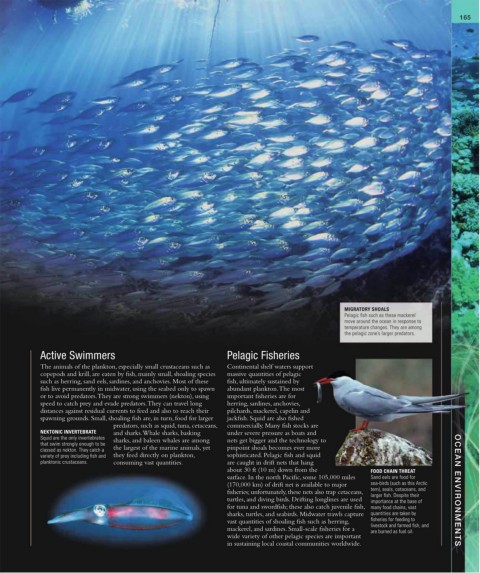
                                                                                                        MIGRATORY SHOALS
                                                                                                        Pelagic fish such as these mackerel
                                                                                                        move around the ocean in response to
                                                                                                        temperature changes. They are among
                                                                                                        the pelagic zone’s larger predators.

             Active Swimmers                                         Pelagic Fisheries

             The animals of the plankton, especially small crustaceans such as    Continental shelf waters support
             copepods and krill, are eaten by fish, mainly small, shoaling species   massive quantities of pelagic
             such as herring, sand eels, sardines, and anchovies. Most of these   fish, ultimately sustained by
             fish live permanently in midwater, using the seabed only to spawn   abundant plankton. The most
             or to avoid predators. They are strong swimmers (nekton), using   important fisheries are for
             speed to catch prey and evade predators. They can travel long   herring, sardines, anchovies,
             distances against residual currents to feed and also to reach their   pilchards, mackerel, capelin and
             spawning grounds. Small, shoaling fish are, in turn, food for larger   jackfish. Squid are also fished
                                   predators, such as squid, tuna, cetaceans,   commercially. Many fish stocks are
             NEKTONIC INVERTEBRATE  and sharks. Whale sharks, basking   under severe pressure as boats and
             Squid are the only invertebrates   sharks, and baleen whales are among   nets get bigger and the technology to
             that swim strongly enough to be
             classed as nekton. They catch a   the largest of the marine animals, yet   pinpoint shoals becomes ever more
             variety of prey including fish and   they feed directly on plankton,   sophisticated. Pelagic fish and squid
             planktonic crustaceans.   consuming vast quantities.    are caught in drift nets that hang
                                                                     about 30 ft (10 m) down from the          FOOD CHAIN THREAT
                                                                     surface. In the north Pacific, some 105,000 miles   Sand eels are food for
                                                                     (170,000 km) of drift net is available to major   sea-birds (such as this Arctic
                                                                                                               tern), seals, cetaceans, and   OCEAN ENVIRONMENTS
                                                                     fisheries; unfortunately, these nets also trap cetaceans,
                                                                                                               larger fish. Despite their
                                                                     turtles, and diving birds. Drifting longlines are used   importance at the base of
                                                                     for tuna and swordfish; these also catch juvenile fish,  many food chains, vast
                                                                     sharks, turtles, and seabirds. Midwater trawls capture  quantities are taken by
                                                                     vast quantities of shoaling fish such as herring,   fisheries for feeding to
                                                                                                               livestock and farmed fish, and
                                                                     mackerel, and sardines. Small-scale fisheries for a
                                                                                                               are burned as fuel oil.
                                                                     wide variety of other pelagic species are important
                                                                     in sustaining local coastal communities worldwide.

