


Page 157 - (DK) Ocean - The Definitive Visual Guide
P. 157
CORAL REEFS 155
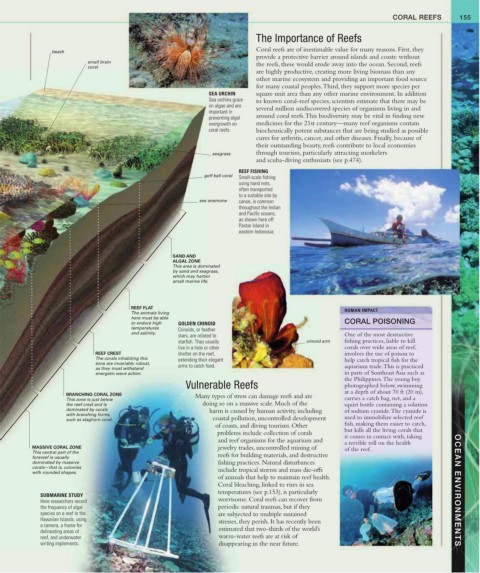
The Importance of Reefs
Coral reefs are of inestimable value for many reasons. First, they
beach
provide a protective barrier around islands and coasts: without
small brain the reefs, these would erode away into the ocean. Second, reefs
coral
are highly productive, creating more living biomass than any
other marine ecosystem and providing an important food source
for many coastal peoples. Third, they support more species per
SEA URCHIN square unit area than any other marine environment. In addition
Sea urchins graze to known coral-reef species, scientists estimate that there may be
on algae and are several million undiscovered species of organisms living in and
important in
preventing algal around coral reefs. This biodiversity may be vital in finding new
overgrowth on medicines for the 21st century—many reef organisms contain
coral reefs. biochemically potent substances that are being studied as possible
cures for arthritis, cancer, and other diseases. Finally, because of
their outstanding beauty, reefs contribute to local economies
seagrass through tourism, particularly attracting snorkelers
and scuba-diving enthusiasts (see p.474).
REEF FISHING
golf ball coral
Small-scale fishing
using hand nets,
often transported
to a suitable site by
sea anemone canoe, is common
throughout the Indian
and Pacific oceans,
as shown here off
Pantar Island in
eastern Indonesia.
SAND AND
ALGAL ZONE
This area is dominated
by sand and seagrass,
which may harbor
small marine life.
REEF FLAT HUMAN IMPACT
The animals living
here must be able
to endure high GOLDEN CRINOID CORAL POISONING
temperatures Crinoids, or feather
and salinity.
stars, are related to One of the most destructive
starfish. They usually crinoid arm fishing practices, liable to kill
live in a hole or other corals over wide areas of reef,
shelter on the reef, involves the use of poison to
REEF CREST
The corals inhabiting this extending their elegant help catch tropical fish for the
zone are invariably robust, arms to catch food.
as they must withstand aquarium trade. This is practiced
energetic wave action. in parts of Southeast Asia such as
the Philippines. The young boy
Vulnerable Reefs photographed below, swimming
at a depth of about 70 ft (20 m),
BRANCHING CORAL ZONE Many types of stress can damage reefs and are
This zone is just below carries a catch bag, net, and a
the reef crest and is doing so on a massive scale. Much of the squirt bottle containing a solution
dominated by corals harm is caused by human activity, including of sodium cyanide. The cyanide is
with branching forms, used to immobilize selected reef
such as staghorn coral. coastal pollution, uncontrolled development
of coasts, and diving tourism. Other fish, making them easier to catch,
problems include collection of corals but kills all the living corals that
it comes in contact with, taking
and reef organisms for the aquarium and a terrible toll on the health
jewelry trades, uncontrolled mining of
MASSIVE CORAL ZONE of the reef.
This central part of the
forereef is usually reefs for building materials, and destructive
dominated by massive fishing practices. Natural disturbances
corals—that is, colonies
with rounded shapes. include tropical storms and mass die-offs
of animals that help to maintain reef health.
Coral bleaching, linked to rises in sea
temperatures (see p.153), is particularly OCEAN ENVIRONMENTS
SUBMARINE STUDY
Here researchers record worrisome. Coral reefs can recover from
the frequency of algal periodic natural traumas, but if they
species on a reef in the are subjected to multiple sustained
Hawaiian Islands, using stresses, they perish. It has recently been
a camera, a frame for
delineating areas of estimated that two-thirds of the world’s
reef, and underwater warm-water reefs are at risk of
writing implements. disappearing in the near future.

