


Page 208 - (DK) Ocean - The Definitive Visual Guide
P. 208
206     INTRODUCTION TO OCEAN LIFE


               Classification


               BY CLASSIFYING ORGANISMS AND FITTING them into a universally accepted
               framework, scientists have created a massive reference system that accommodates            WHAT IS
               all forms of life. Over 2 million organisms have been described, of which about 16         A SPECIES?
               percent live in the oceans. The marine proportion is likely to increase because many       A species is the basic unit of
                                                                                                          classification. One commonly
               new species continue to be discovered annually, particularly in the deep ocean.            accepted definition of a species
                                                                                                          is a group of living organisms
                 LINNAEAN HIERARCHY                         Principles of Classification                   that have so many features in
                 Linnaeus used a hierarchy of ranked categories of   Classification helps us make sense of the natural   common that they can interbreed
                                                                                                          and exchange genes in natural
                 increasing exclusiveness. Today’s expanded system                                        conditions. This definition cannot
                 includes many ranks, from domain down to species.   world by grouping organisms on the basis of features   be applied to fossil species. It
                 Below is an example of a series of ranked categories,   that they share. It gives scientists a clear and accurate   also does not work for Bacteria
                 illustrating those that classify the common dolphin.   understanding of the diversity of life, and because   and Archaea and there can be no
                                                            everyone uses the same system, the knowledge is
                           DOMAIN Eucarya                                                                 one universal definition. Other
                           Includes all Eukaryotes—organisms that    accessible on a worldwide basis. The hierarchical   factors such as geographical
                           have complex cells with distinct nuclei. Only   system devised by the Swedish scientist Carolus   isolation and DNA (see below)
                           bacteria and archaea fall outside this domain.  Linnaeus (see panel, left) in the 18th century still   are also important.
                                                            forms the basis of today’s classification. Each species
                           KINGDOM Animalia
                           Includes all animals—multicellular eukaryotes   is identified with a unique two-part scientific name
                           that need to eat food for energy. All animals   (made up of the genus and species names), then categorized in a series of ever-larger
                           are mobile for at least part of their lives.
                                                            groupings. However, as our knowledge increases, it is often necessary to revise the
                           PHYLUM Chordata                  groups. Sometimes, this leads to subdivision of categories, for example phylum
                           Includes all chordates—animals possessing    Arthropoda has been split into four subphyla. Many new species are discovered each
                           a notochord. In most cases, the notochord    year but describing and publishing them is laborious and time-consuming.
                           is replaced before birth by the backbone.
                           CLASS Mammalia
                           Includes all mammals—air-breathing
                           chordates that feed their young on milk.                   The Evidence
                           The jaw is made up of a single bone.
                                                                                      In the past, scientists could identify and classify organisms
                           ORDER Cetartiodactyla                                      only by studying anatomy, by looking at form, function,
                           Includes all cetaceans (whales and dolphins)—
                           marine mammals that have a tail with                       and embryological development (animals only), and by
                           boneless, horizontal flukes for propulsion.                examining the fossil record. Recently, scientists have also
                                                                                      been able to investigate organisms by looking at their
                           FAMILY Delphinidae                                                          proteins and their DNA. DNA is a
                           Includes all dolphins (a subgroup of toothed               DETAILED ANATOMY
                           cetaceans) with beaks and 50–100 vertebrae.                By making a detailed   complex molecule whose sequential
                           The skull lacks a crest.                                   anatomical examination   structure is unique to each organism.
                                                                                      of material in museum   The relatedness of organisms can
                           GENUS Delphinus                                            collections, scientists
                           Includes a few colorful, oceanic dolphins                  can distinguish between    be determined by comparing these
                           with 40–50 teeth on each side of the jaw.                  similar organisms and   DNA molecules for shared features.
                           These dolphins form large social groups.                                    This molecular evidence has led to
                                                                                      classify them according
                                                                                      to shared characters.  many revisions of classification.
                           SPECIES Delphinus delphis
                           Specifies a single type of dolphin with a
                           V-shaped black cape under the dorsal fin and
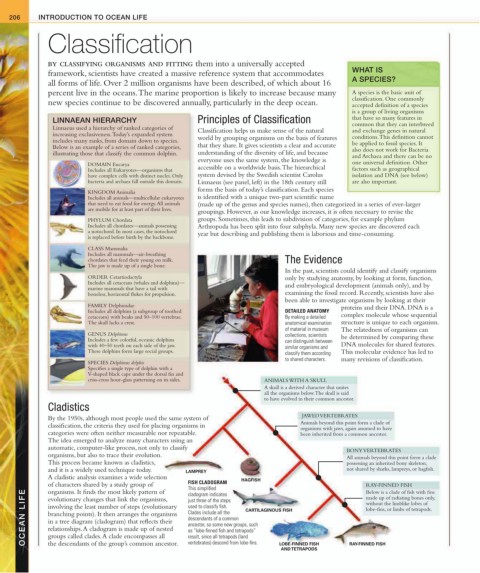
                           criss-cross hour-glass patterning on its sides.      ANIMALS WITH A SKULL
                                                                                A skull is a derived character that unites
                                                                                all the organisms below. The skull is said
                                                                                to have evolved in their common ancestor.
               Cladistics
               By the 1950s, although most people used the same system of                  JAWED VERTEBRATES
                                                                                          Animals beyond this point form a clade of
               classification, the criteria they used for placing organisms in            organisms with jaws, again assumed to have
               categories were often neither measurable nor repeatable.                   been inherited from a common ancestor.
               The idea emerged to analyze many characters using an
               automatic, computer-like process, not only to classify
                                                                                                        BONY VERTEBRATES
               organisms, but also to trace their evolution.
                                                                                                        All animals beyond this point form a clade
               This process became known as cladistics,                                                 possessing an inherited bony skeleton,
               and it is a widely used technique today.                                                 not shared by sharks, lampreys, or hagfish.
                                                        LAMPREY
               A cladistic analysis examines a wide selection
               of characters shared by a study group of   FISH CLADOGRAM  HAGFISH                             RAY-FINNED FISH
                                                         This simplified
               organisms. It finds the most likely pattern of
        OCEAN LIFE  involving the least number of steps (evolutionary   used to classify fish.   CARTILAGINOUS FISH  without the limblike lobes of
                                                                                                              Below is a clade of fish with fins
                                                         cladogram indicates
                                                                                                              made up of radiating bones only,
               evolutionary changes that link the organisms,
                                                         just three of the steps
                                                                                                              lobe-fins, or limbs of tetrapods.
                                                         Clades include all the
               branching points). It then arranges the organisms
                                                         descendants of a common
               in a tree diagram (cladogram) that reflects their
                                                         ancestor, so some new groups, such
               relationships. A cladogram is made up of nested
                                                         as “lobe-finned fish and tetrapods”
               groups called clades. A clade encompasses all
                                                         result, since all tetrapods (land
                                                         vertebrates) descend from lobe-fins.
               the descendants of the group’s common ancestor.
                                                                                    LOBE-FINNED FISH
                                                                                     AND TETRAPODS       RAY-FINNED FISH

