


Page 209 - (DK) Ocean - The Definitive Visual Guide
P. 209
CLASSIFICATION         207


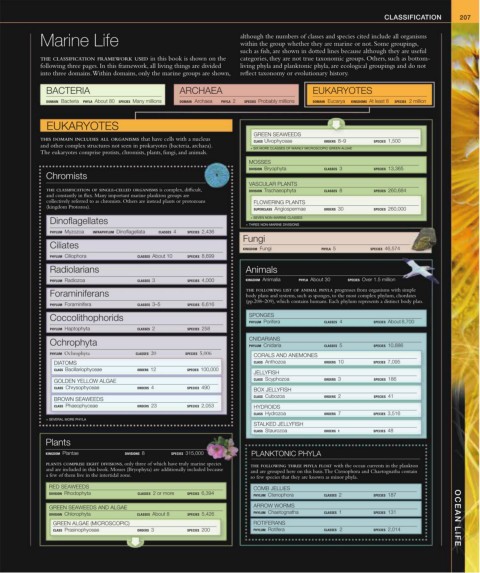
             Marine Life                                                 although the numbers of classes and species cited include all organisms
                                                                         within the group whether they are marine or not. Some groupings,
                                                                         such as fish, are shown in dotted lines because although they are useful
             THE CLASSIFICATION FRAMEWORK USED in this book is shown on the   categories, they are not true taxonomic groups. Others, such as bottom-
             following three pages. In this framework, all living things are divided   living phyla and planktonic phyla, are ecological groupings and do not
             into three domains. Within domains, only the marine groups are shown,   reflect taxonomy or evolutionary history.

               BACTERIA                               ARCHAEA                                 EUKARYOTES
               DOMAIN   Bacteria   PHYLA   About 80   SPECIES   Many millions  DOMAIN   Archaea    PHYLA   2    SPECIES   Probably millions   DOMAIN   Eucarya   KINGDOMS   At least 8   SPECIES  2 million


               EUKARYOTES
                                                                             GREEN SEAWEEDS
             THIS DOMAIN INCLUDES ALL ORGANISMS that have cells with a nucleus   CLASS  Ulvophyceae   ORDERS   8–9   SPECIES   1,500
             and other complex structures not seen in prokaryotes (bacteria, archaea).
                                                                            + SIX MORE CLASSES OF MAINLY MICROSCOPIC GREEN ALGAE
             The eukaryotes comprise protists, chromists, plants, fungi, and animals.
                                                                           MOSSES
                                                                           DIVISION   Bryophyta   CLASSES   3   SPECIES   13,365
               Chromists
                                                                           VASCULAR PLANTS
               THE CLASSIFICATION OF SINGLE-CELLED ORGANISMS is complex, difficult,    DIVISION   Trachaeophyta   CLASSES   8   SPECIES   260,684
               and constantly in flux. Many important marine plankton groups are
               collectively referred to as chromists. Others are instead plants or protozoans   FLOWERING PLANTS
               (kingdom Protozoa).
                                                                             SUPERCLASS   Angiospermae   ORDERS   30   SPECIES   260,000
                Dinoflagellates                                              + SEVEN NON-MARINE CLASSES
                                                                          + THREE NON-MARINE DIVISIONS
                PHYLUM   Myzozoa   INFRAPHYLUM   Dinoflagellata   CLASSES   4   SPECIES   2,436
                                                                         Fungi
                Ciliates                                                 KINGDOM   Fungi         PHYLA   5     SPECIES   46,574

                PHYLUM   Ciliophora       CLASSES   About 10   SPECIES   8,699
                Radiolarians                                              Animals

                PHYLUM   Radiozoa         CLASSES   3    SPECIES   4,000  KINGDOM   Animalia   PHYLA   About 30   SPECIES   Over 1.5 million
                Foraminiferans                                            THE FOLLOWING LIST OF ANIMAL PHYLA progresses from organisms with simple
                                                                          body plans and systems, such as sponges, to the most complex phylum, chordates
                PHYLUM   Foraminifera     CLASSES   3–5   SPECIES   6,616  (pp.208–209), which contains humans. Each phylum represents a distinct body plan.
                Coccolithophorids                                          SPONGES
                                                                           PHYLUM   Porifera      CLASSES   4   SPECIES   About 8,700
                PHYLUM   Haptophyta       CLASSES   2    SPECIES   258
                Ochrophyta                                                 CNIDARIANS             CLASSES   5   SPECIES   10,886
                                                                           PHYLUM   Cnidaria
                PHYLUM   Ochrophyta      CLASSES   20   SPECIES   5,006      CORALS AND ANEMONES
                 DIATOMS                                                     CLASS   Anthozoa     ORDERS   10   SPECIES   7,095
                 CLASS   Bacillariophyceae   ORDERS   12   SPECIES   100,000
                                                                             JELLYFISH
                 GOLDEN YELLOW ALGAE                                         CLASS   Scyphozoa    ORDERS   3    SPECIES   186
                 CLASS   Chrysophyceae    ORDERS   4     SPECIES   490       BOX JELLYFISH
                 BROWN SEAWEEDS                                              CLASS   Cubozoa      ORDERS   2    SPECIES   41
                 CLASS   Phaeophyceae     ORDERS   23    SPECIES   2,053     HYDROIDS
                                                                             CLASS   Hydrozoa     ORDERS   7    SPECIES   3,516
               + SEVERAL MORE PHYLA
                                                                             STALKED JELLYFISH
                                                                             CLASS   Staurozoa    ORDERS   1    SPECIES   48
               Plants

               KINGDOM   Plantae      DIVISIONS   8   SPECIES   315,000     PLANKTONIC PHYLA
               PLANTS COMPRISE EIGHT DIVISIONS, only three of which have truly marine species   THE FOLLOWING THREE PHYLA FLOAT with the ocean currents in the plankton
               and are included in this book. Mosses (Bryophyta) are additionally included because   and are grouped here on this basis. The Ctenophora and Chaetognatha contain
               a few of them live in the intertidal zone.
                                                                            so few species that they are known as minor phyla.
               RED SEAWEEDS                                                 COMB JELLIES
               DIVISION   Rhodophyta      CLASSES   2 or more   SPECIES   6,394  PHYLUM   Ctenophora   CLASSES   2   SPECIES   187
                GREEN SEAWEEDS AND ALGAE                                    ARROW WORMS
                DIVISION   Chlorophyta    CLASSES   About 8   SPECIES   5,426  PHYLUM   Chaetognatha   CLASSES   1   SPECIES   131       OCEAN LIFE
                 GREEN ALGAE (MICROSCOPIC)                                  ROTIFERANS
                 CLASS   Prasinophyceae   ORDERS   3     SPECIES   200      PHYLUM   Rotifera    CLASSES    2   SPECIES   2,014

