


Page 203 - (DK) Ocean - The Definitive Visual Guide
P. 203
201
Arctic Deep-water Circulation MISTY SEAS
The seas around the
In the deeper waters of the Arctic, there is a slow circulation
Antarctic Convergence
of cold, dense water. This circulation is restricted by the structure are prone to mists. Here,
of the Arctic Ocean, which consists of a central deep basin (the a cruise liner approaches
Arctic Basin), bisected by several underwater ridges and surrounded a channel just south of
the Convergence.
on most sides by shallow continental shelf. Only on the Atlantic side
is there a connection between the deep waters of the Arctic and deep The Antarctic Convergence
ocean waters to the south. On the opposite side, the connection
with the Pacific is via the shallow and narrow Bering Strait. What The Antarctic Convergence is a region of the Southern Ocean
little circulation of water occurs in the Arctic Basin mostly involves encircling Antarctica, located roughly at latitude 55˚S (but deviating
influxes of Atlantic water at various depths to the north of Russia, from this in places), where cold, northward-flowing waters from
and outflows around Greenland. Antarctica sink beneath the relatively warmer waters to the north.
At the Convergence, there is a sudden change in surface ocean
temperature of 5–9˚F (3–5˚C) as well as alterations in the chemical
composition of seawater. As a result, the Convergence forms a barrier
to the movement of animal species, and the groups of marine animals
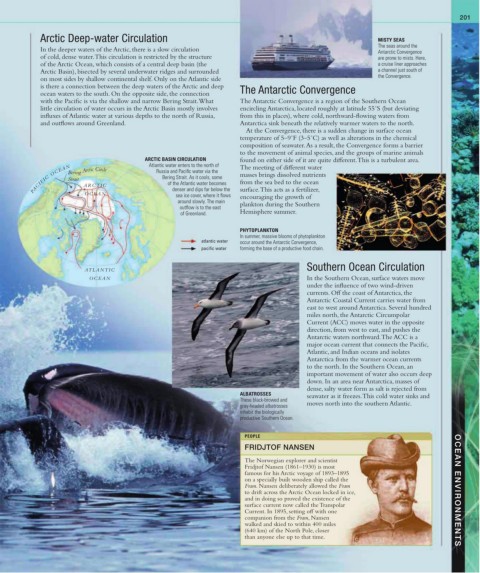
ARCTIC BASIN CIRCULATION found on either side of it are quite different. This is a turbulent area.
Atlantic water enters to the north of
The meeting of different water
PACIFIC OCEAN Bering Arctic Circle Russia and Pacific water via the masses brings dissolved nutrients
Bering Strait. As it cools, some
Strait
from the sea bed to the ocean
of the Atlantic water becomes
ARCTIC
denser and dips far below the
OCEAN
sea ice cover, where it flows surface. This acts as a fertilizer,
encouraging the growth of
around slowly. The main
outflow is to the east plankton during the Southern
of Greenland. Hemisphere summer.
PHYTOPLANKTON
In summer, massive blooms of phytoplankton
atlantic water occur around the Antarctic Convergence,
pacific water forming the base of a productive food chain.
Southern Ocean Circulation
ATLANTIC
OCEAN In the Southern Ocean, surface waters move
under the influence of two wind-driven
currents. Off the coast of Antarctica, the
Antarctic Coastal Current carries water from
east to west around Antarctica. Several hundred
miles north, the Antarctic Circumpolar
Current (ACC) moves water in the opposite
direction, from west to east, and pushes the
Antarctic waters northward. The ACC is a
major ocean current that connects the Pacific,
Atlantic, and Indian oceans and isolates
Antarctica from the warmer ocean currents
to the north. In the Southern Ocean, an
important movement of water also occurs deep
down. In an area near Antarctica, masses of
dense, salty water form as salt is rejected from
ALBATROSSES seawater as it freezes. This cold water sinks and
These black-browed and
gray-headed albatrosses moves north into the southern Atlantic.
inhabit the biologically
productive Southern Ocean.
PEOPLE
FRIDJTOF NANSEN
The Norwegian explorer and scientist
Fridjtof Nansen (1861–1930) is most
famous for his Arctic voyage of 1893–1895
on a specially built wooden ship called the
Fram. Nansen deliberately allowed the Fram
to drift across the Arctic Ocean locked in ice, OCEAN ENVIRONMENTS
and in doing so proved the existence of the
surface current now called the Transpolar
Current. In 1895, setting off with one
companion from the Fram, Nansen
walked and skied to within 400 miles
(640 km) of the North Pole, closer
than anyone else up to that time.

