Page 214 - (DK) Ocean - The Definitive Visual Guide
P. 214
212     INTRODUCTION TO OCEAN LIFE


               Cycles of Life and Energy


               ALL LIFE DEPENDS ON ORGANISMS that harness energy           Recycling
               from either chemicals or the Sun to produce food.
                                                                           All living things need a supply of chemical nutrients, such as nitrates,
               These organisms, whether phytoplankton, seaweeds, or
                                                                           phosphates, and silicates, to grow and reproduce. They are taken up by
               bacteria, are called primary producers and form the first  primary producers then passed along the food chain. Although some
               link of a food chain. This first link is just one point in    nutrients are available from seawater, most are derived ultimately from
                                                                           the sea floor. When an organism dies, any parts that are not eaten by
               a cycle that processes chemical energy and nutrients
                                                                           other animals gradually sink to the sea floor, where they are broken
               through the entire community of life in an ecosystem,       down by bacteria and other decomposers. Fecal matter also ends up
               into the physical environment, and back again.              on the seabed and is processed by detritus feeders or decomposers.
                                                                           Eventually, the nutrients are released into the environment in their
               Energy Flow                                                 mineral, nonliving forms. They may then remain at depth, or they
                                                                           may be returned to surface waters by circulating water currents
               As each organism in an ecosystem is eaten in turn by the next organism   within an ocean basin (see upwelling, opposite).
               in the food chain, food energy flows from prey to consumer. The
               primary producers—the organisms such as diatoms and bacteria at the   upwelling of nutrients   NUTRIENT CYCLE
               beginning of the food chain—are eaten by organisms called primary   released by bacteria
                                                                                                        Small particles of organic matter, or
               consumers, which are eaten by secondary consumers, and so on to top   phytoplankton absorbs sunlight   detritus, are found in the water column.
               predators—animals not preyed upon by anything else. In land-based   and use nutrients to grow  They may be eaten by scavengers or
               ecosystems, the total mass of organisms at each succeeding food-chain     zooplankton feed    broken down still further by bacteria
               level decreases, leaving very few top predators. However, in marine       on phytoplankton  present in the water. However, many of
                                                                                                        them rain down on the ocean floor where
               ecosystems with phytoplankton as producers, the mass is greatest at the                  they decompose, releasing nutrients. The
               primary consumer level. This is possible because phytoplankton grow                      nutrient cycle is completed by upwelling
               so rapidly that they provide great turnover despite having little mass.                  water currents that then carry the nutrients
                                                                                                        back to the surface where they can be
                                                                                                        utilized by the phytoplankton.
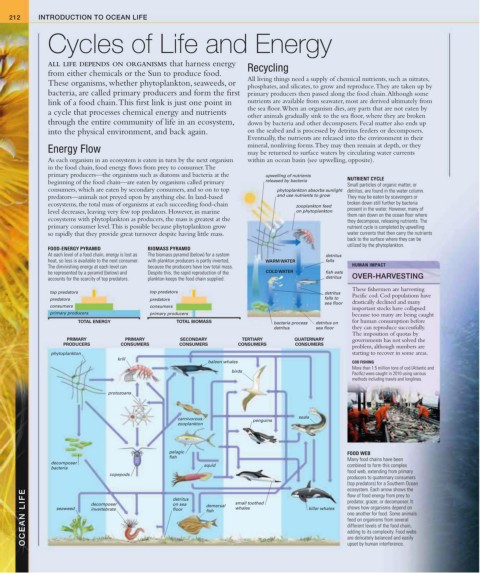
               FOOD-ENERGY PYRAMID           BIOMASS PYRAMID
               At each level of a food chain, energy is lost as   The biomass pyramid (below) for a system   detritus
               heat, so less is available to the next consumer.   with plankton producers is partly inverted,   WARM WATER  falls
               The diminishing energy at each level can    because the producers have low total mass.     HUMAN IMPACT
               be represented by a pyramid (below) and   Despite this, the rapid reproduction of the   COLD WATER  fish eats   OVER-HARVESTING
               accounts for the scarcity of top predators.  plankton keeps the food chain supplied.   detritus
                                                                                                          These fishermen are harvesting
                top predators                 top predators                                       detritus   Pacific cod. Cod populations have
                predators                     predators                                           falls to
                                                                                                  sea floor  drastically declined and many
                consumers                     consumers
                                                                                                          important stocks have collapsed
                primary producers             primary producers                                           because too many are being caught
                                                                                   bacteria process   detritus on   for human consumption before
                        TOTAL ENERGY                  TOTAL BIOMASS
                                                                                   detritus    sea floor   they can reproduce successfully.
                                                                                                          The imposition of quotas by
                                                                                                          governments has not solved the
                     PRIMARY          PRIMARY          SECONDARY         TERTIARY        QUATERNARY
                                                                                                          problem, although numbers are
                    PRODUCERS        CONSUMERS        CONSUMERS         CONSUMERS        CONSUMERS
                phytoplankton                                                                             starting to recover in some areas.
                                    krill
                                                               baleen whales                              COD FISHING
                                                                                                          More than 1.5 million tons of cod (Atlantic and
                                                                      birds
                                                                                                          Pacific) were caught in 2010 using various
                                                                                                          methods including trawls and longlines.
                                 protozoans

                                                      carnivorous           penguins      seals
                                                      zooplankton


                                                   pelagic                                              FOOD WEB
                                                   fish                                                  Many food chains have been
                decomposer                                    squid                                     combined to form this complex
                bacteria
                                                                                                        food web, extending from primary
                                  copepods
                                                                                                        producers to quaternary consumers
                                                                                                        (top predators) for a Southern Ocean
                                                                                                        ecosystem. Each arrow shows the
        OCEAN LIFE  seaweed  decomposer             on sea    demersal  small toothed        killer whales  predator, grazer, or decomposer. It
                                                                                                        flow of food energy from prey to
                                                    detritus
                                                                                                        shows how organisms depend on
                                                                       whales
                            invertebrate
                                                    floor
                                                              fish
                                                                                                        one another for food. Some animals
                                                                                                        feed on organisms from several
                                                                                                        different levels of the food chain,
                                                                                                        adding to its complexity. Food webs
                                                                                                        are delicately balanced and easily
                                                                                                        upset by human interference.
   209   210   211   212   213   214   215   216   217   218   219