


Page 367 - (DK) Ocean - The Definitive Visual Guide
P. 367
BONY FISHES 365
ORDER PERCIFORMES
Great Barracuda
Sphyraena barracuda
LENGTH
1
Up to 6 / 2 ft (2 m)
WEIGHT
Up to 110 lb (50 kg)
DEPTH
0–330 ft (0–100 m)
DISTRIBUTION Tropical and subtropical waters
worldwide
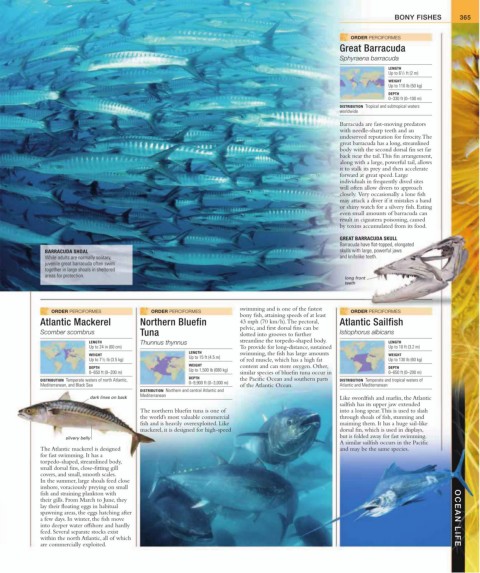
Barracuda are fast-moving predators
with needle-sharp teeth and an
undeserved reputation for ferocity. The
great barracuda has a long, streamlined
body with the second dorsal fin set far
back near the tail. This fin arrangement,
along with a large, powerful tail, allows
it to stalk its prey and then accelerate
forward at great speed. Large
individuals in frequently dived sites
will often allow divers to approach
closely. Very occasionally a lone fish
may attack a diver if it mistakes a hand
or shiny watch for a silvery fish. Eating
even small amounts of barracuda can
result in ciguatera poisoning, caused
by toxins accumulated from its food.
GREAT BARRACUDA SKULL
Barracuda have flat-topped, elongated
BARRACUDA SHOAL skulls with large, powerful jaws
While adults are normally solitary, and knifelike teeth.
juvenile great barracuda often swim
together in large shoals in sheltered
areas for protection.
long front
teeth
ORDER PERCIFORMES ORDER PERCIFORMES swimming and is one of the fastest ORDER PERCIFORMES
bony fish, attaining speeds of at least
Atlantic Mackerel Northern Bluefin 43 mph (70 km/h). The pectoral, Atlantic Sailfish
pelvic, and first dorsal fins can be
Tuna
Scomber scombrus slotted into grooves to further Istiophorus albicans
LENGTH streamline the torpedo-shaped body. LENGTH
Thunnus thynnus
Up to 24 in (60 cm) To provide for long-distance, sustained Up to 10 ft (3.2 m)
LENGTH
WEIGHT Up to 15 ft (4.5 m) swimming, the fish has large amounts WEIGHT
Up to 7 1 / 2 lb (3.5 kg) of red muscle, which has a high fat Up to 130 lb (60 kg)
WEIGHT
DEPTH Up to 1,500 lb (680 kg) content and can store oxygen. Other, DEPTH
0–650 ft (0–200 m) similar species of bluefin tuna occur in 0–650 ft (0–200 m)
DEPTH
DISTRIBUTION Temperate waters of north Atlantic, 0–9,900 ft (0–3,000 m) the Pacific Ocean and southern parts DISTRIBUTION Temperate and tropical waters of
Mediterranean, and Black Sea of the Atlantic Ocean. Atlantic and Mediterranean
DISTRIBUTION Northern and central Atlantic and
Mediterranean
dark lines on back Like swordfish and marlin, the Atlantic
sailfish has its upper jaw extended
The northern bluefin tuna is one of into a long spear. This is used to slash
the world’s most valuable commercial through shoals of fish, stunning and
fish and is heavily overexploited. Like maiming them. It has a huge sail-like
mackerel, it is designed for high-speed dorsal fin, which is used in displays,
silvery belly but is folded away for fast swimming.
A similar sailfish occurs in the Pacific
The Atlantic mackerel is designed and may be the same species.
for fast swimming. It has a
torpedo-shaped, streamlined body,
small dorsal fins, close-fitting gill
covers, and small, smooth scales.
In the summer, large shoals feed close
inshore, voraciously preying on small
fish and straining plankton with
their gills. From March to June, they
lay their floating eggs in habitual
spawning areas, the eggs hatching after
a few days. In winter, the fish move OCEAN LIFE
into deeper water offshore and hardly
feed. Several separate stocks exist
within the north Atlantic, all of which
are commercially exploited.

