Page 366 - (DK) Ocean - The Definitive Visual Guide
P. 366
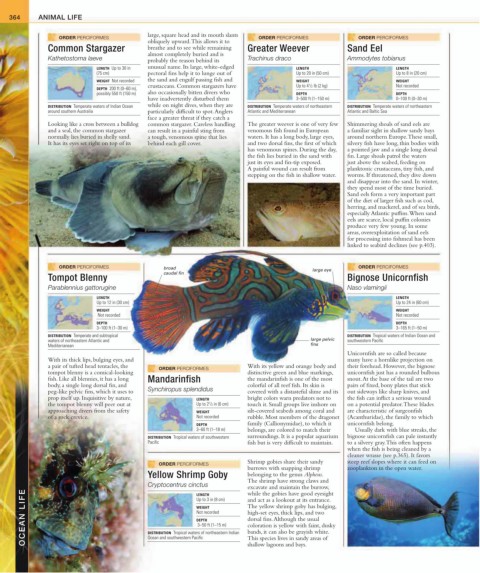
364     ANIMAL LIFE


                  ORDER PERCIFORMES          large, square head and its mouth slants   ORDER PERCIFORMES    ORDER PERCIFORMES
                                             obliquely upward. This allows it to
               Common Stargazer              breathe and to see while remaining   Greater Weever        Sand Eel
                                             almost completely buried and is
               Kathetostoma laeve            probably the reason behind its    Trachinus draco          Ammodytes tobianus
                              LENGTH  Up to 30 in   unusual name. Its large, white-edged   LENGTH                      LENGTH
                              (75 cm)        pectoral fins help it to lunge out of       Up to 20 in (50 cm)           Up to 8 in (20 cm)
                              WEIGHT  Not recorded  the sand and engulf passing fish and   WEIGHT                      WEIGHT
                                             crustaceans. Common stargazers have         Up to 4 1 / 2 lb (2 kg)       Not recorded
                              DEPTH  200 ft (0–60 m),
                              possibly 550 ft (150 m)   also occasionally bitten divers who   DEPTH                    DEPTH
                                             have inadvertently disturbed them           3–500 ft (1–150 m)            0–100 ft (0–30 m)
               DISTRIBUTION  Temperate waters of Indian Ocean   while on night dives, when they are   DISTRIBUTION  Temperate waters of northeastern   DISTRIBUTION  Temperate waters of northeastern
               around southern Australia     particularly difficult to spot. Anglers   Atlantic and Mediterranean  Atlantic and Baltic Sea
                                             face a greater threat if they catch a
               Looking like a cross between a bulldog   common stargazer. Careless handling   The greater weever is one of very few   Shimmering shoals of sand eels are
               and a seal, the common stargazer   can result in a painful sting from    venomous fish found in European   a familiar sight in shallow sandy bays
               normally lies buried in shelly sand.    a tough, venomous spine that lies   waters. It has a long body, large eyes,   around northern Europe. These small,
               It has its eyes set right on top of its   behind each gill cover.   and two dorsal fins, the first of which   silvery fish have long, thin bodies with
                                                                           has venomous spines. During the day,   a pointed jaw and a single long dorsal
                                                                           the fish lies buried in the sand with   fin. Large shoals patrol the waters
                                                                           just its eyes and fin-tip exposed.     just above the seabed, feeding on
                                                                           A painful wound can result from   planktonic crustaceans, tiny fish, and
                                                                           stepping on the fish in shallow water.    worms. If threatened, they dive down
                                                                                                        and disappear into the sand. In winter,
                                                                                                        they spend most of the time buried.
                                                                                                        Sand eels form a very important part
                                                                                                        of the diet of larger fish such as cod,
                                                                                                        herring, and mackerel, and of sea birds,
                                                                                                        especially Atlantic puffins. When sand
                                                                                                        eels are scarce, local puffin colonies
                                                                                                        produce very few young. In some
                                                                                                        areas, overexploitation of sand eels
                                                                                                        for processing into fishmeal has been
                                                                                                        linked to seabird declines (see p.403).


                  ORDER PERCIFORMES               broad                                       large eye     ORDER PERCIFORMES
                                                  caudal fin
               Tompot Blenny                                                                            Bignose Unicornfish

               Parablennius gattorugine                                                                 Naso vlamingii
                              LENGTH                                                                                   LENGTH
                              Up to 12 in (30 cm)                                                                      Up to 24 in (60 cm)
                              WEIGHT                                                                                   WEIGHT
                               Not recorded                                                                            Not recorded
                              DEPTH                                                                                    DEPTH
                              3–100 ft (1–30 m)                                                                        3–165 ft (1–50 m)
               DISTRIBUTION  Temperate and subtropical                                                  DISTRIBUTION  Tropical waters of Indian Ocean and
               waters of northeastern Atlantic and                                           large pelvic   southwestern Pacific
               Mediterranean                                                                 fins
                                                                                                        Unicornfish are so called because
               With its thick lips, bulging eyes, and                                                   many have a hornlike projection on
               a pair of tufted head tentacles, the   ORDER PERCIFORMES    With its yellow and orange body and   their forehead. However, the bignose
               tompot blenny is a comical-looking                          distinctive green and blue markings,   unicornfish just has a rounded bulbous
               fish. Like all blennies, it has a long   Mandarinfish       the mandarinfish is one of the most   snout. At the base of the tail are two
               body, a single long dorsal fin, and                         colorful of all reef fish. Its skin is   pairs of fixed, bony plates that stick
               peg-like pelvic fins, which it uses to   Synchiropus splendidus  covered with a distasteful slime and its   out sideways like sharp knives, and
               prop itself up. Inquisitive by nature,      LENGTH          bright colors warn predators not to   the fish can inflict a serious wound
                                                               1
               the tompot blenny will peer out at          Up to 2 / 2 in (6 cm)  touch it. Small groups live inshore on   on a potential predator. These blades
               approaching divers from the safety          WEIGHT          silt-covered seabeds among coral and   are characteristic of surgeonfish
               of a rock crevice.                          Not recorded    rubble. Most members of the dragonet   (Acanthuridae), the family to which
                                                           DEPTH           family (Callionymidae), to which it   unicornfish belong.
                                                           3–60 ft (1–18 m)  belongs, are colored to match their   Usually dark with blue streaks, the
                                             DISTRIBUTION  Tropical waters of southwestern   surroundings. It is a popular aquarium   bignose unicornfish can pale instantly
                                             Pacific                        fish but is very difficult to maintain.   to a silvery gray. This often happens
                                                                                                        when the fish is being cleaned by a
                                                                                                        cleaner wrasse (see p.365). It favors
                                                ORDER PERCIFORMES          Shrimp gobies share their sandy   steep reef slopes where it can feed on
                                                                           burrows with snapping shrimp   zooplankton in the open water.
                                             Yellow Shrimp Goby            belonging to the genus Alpheus.
                                                                           The shrimp have strong claws and
                                                                           excavate and maintain the burrow,
                                             Cryptocentrus cinctus
        OCEAN LIFE                           DISTRIBUTION  Tropical waters of northeastern Indian   The yellow shrimp goby has bulging,
                                                                           while the gobies have good eyesight
                                                           LENGTH
                                                           Up to 3 in (8 cm)
                                                                           and act as a lookout at its entrance.
                                                           WEIGHT
                                                           Not recorded
                                                                           high-set eyes, thick lips, and two
                                                                           dorsal fins. Although the usual
                                                           DEPTH
                                                            3–50 ft (1–15 m)
                                                                           coloration is yellow with faint, dusky
                                                                           bands, it can also be grayish white.
                                             Ocean and southwestern Pacific
                                                                           This species lives in sandy areas of
                                                                           shallow lagoons and bays.
   361   362   363   364   365   366   367   368   369   370   371