


Page 420 - (DK) Ocean - The Definitive Visual Guide
P. 420
418     ANIMAL LIFE


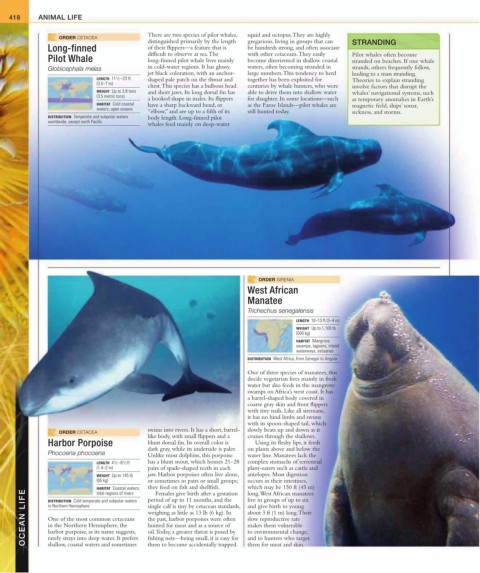
                  ORDER CETACEA              There are two species of pilot whales,   squid and octopus. They are highly
                                             distinguished primarily by the length   gregarious, living in groups that can   STRANDING
               Long-finned                   of their flippers—a feature that is   be hundreds strong, and often associate
                                             difficult to observe at sea. The   with other cetaceans. They easily   Pilot whales often become
               Pilot Whale                   long-finned pilot whale lives mainly   become disoriented in shallow coastal   stranded on beaches. If one whale
                                             in cold-water regions. It has glossy,    waters, often becoming stranded in   strands, others frequently follow,
               Globicephala melas
                                             jet black coloration, with an anchor-  large numbers. This tendency to herd   leading to a mass stranding.
                                   1
                              LENGTH  11 / 2 –23 ft   shaped pale patch on the throat and   together has been exploited for   Theories to explain stranding
                              (3.5–7 m)
                                             chest. This species has a bulbous head   centuries by whale hunters, who were   involve factors that disrupt the
                              WEIGHT  Up to 3.8 tons   and short jaws. Its long dorsal fin has    able to drive them into shallow water   whales’ navigational systems, such
                              (3.5 metric tons)
                                             a hooked shape in males. Its flippers   for slaughter. In some locations—such   as temporary anomalies in Earth’s
                              HABITAT  Cold coastal   have a sharp backward bend, or   as the Faroe Islands—pilot whales are   magnetic field, ships’ sonar,
                              waters, open oceans
                                             “elbow,” and are up to a fifth of its   still hunted today.  sickness, and storms.
               DISTRIBUTION  Temperate and subpolar waters   body length. Long-finned pilot
               worldwide, except north Pacific
                                             whales feed mainly on deep-water


                                                                              ORDER SIRENIA
                                                                           West African
                                                                           Manatee

                                                                           Trichechus senegalensis
                                                                                         LENGTH  10–13 ft (3–4 m)
                                                                                         WEIGHT  Up to 1,100 lb
                                                                                         (500 kg)
                                                                                         HABITAT  Mangrove
                                                                                         swamps, lagoons, inland
                                                                                         waterways, estuaries
                                                                           DISTRIBUTION  West Africa, from Senegal to Angola

                                                                           One of three species of manatees, this
                                                                           docile vegetarian lives mainly in fresh
                                                                           water but also feeds in the mangrove
                                                                           swamps on Africa’s west coast. It has
                                                                           a barrel-shaped body covered in
                                                                           coarse gray skin and front flippers
                                                                           with tiny nails. Like all sirenians,
                                                                           it has no hind limbs and swims
                                                                           with its spoon-shaped tail, which
                  ORDER CETACEA              swims into rivers. It has a short, barrel-  slowly beats up and down as it
                                             like body, with small flippers and a   cruises through the shallows.
               Harbor Porpoise               blunt dorsal fin. Its overall color is   Using its fleshy lips, it feeds
                                             dark gray, while its underside is paler.   on plants above and below the
               Phocoena phocoena             Unlike most dolphins, this porpoise   water line. Manatees lack the
                                   1
                                     1
                              LENGTH  4 / 2 –6 / 2 ft   has a blunt snout, which houses 21–28   complex stomachs of terrestrial
                              (1.4–2 m)      pairs of spade-shaped teeth in each   plant-eaters such as cattle and
                              WEIGHT  Up to 145 lb   jaw. Harbor porpoises often live alone,   antelopes. Most digestion
                              (65 kg)        or sometimes in pairs or small groups;   occurs in their intestines,
                              HABITAT  Coastal waters,   they feed on fish and shellfish.   which may be 150 ft (45 m)
        OCEAN LIFE  in Northern Hemisphere   single calf is tiny by cetacean standards,   and give birth to young
                              tidal regions of rivers
                                                                           long. West African manatees
                                               Females give birth after a gestation
                                             period of up to 11 months, and the
                                                                           live in groups of up to six
               DISTRIBUTION  Cold-temperate and subpolar waters
                                                                           about 3 ft (1 m) long. Their
                                             weighing as little as 13 lb (6 kg). In
               One of the most common cetaceans
                                                                           slow reproductive rate
                                             the past, harbor porpoises were often
               in the Northern Hemisphere, the
                                                                           makes them vulnerable
                                             hunted for meat and as a source of
               harbor porpoise, as its name suggests,
                                             oil. Today, a greater threat is posed by
                                                                           to environmental change,
               rarely strays into deep water. It prefers
                                                                           and to hunters who target
                                             fishing nets—being small, it is easy for
               shallow, coastal waters and sometimes
                                             them to become accidentally trapped.
                                                                           them for meat and skin.

