


Page 419 - (DK) Ocean - The Definitive Visual Guide
P. 419
417


                                     Whale Migration


                                     Many land mammals make long treks in search of
                                                                                         WHALE BEHAVIOR
                                     existing feeding grounds, but the distances they cover
                                     are dwarfed by the vast annual journeys made by some                    ALASKAN FEEDING GROUNDS
                                                                                                             Humpback whales feed by
                                     whale species. Humpback whales, for example, spend
                                                                                                             scooping water into their huge
                                     the summer in rich feeding grounds in cold waters                       mouths, from which they
                                     (see below), gorging themselves on krill, zooplankton,                  mostly filter krill and other large
                                                                                                             zooplankton. In Alaska, however,
                                     and fish. With the onset of winter, their food supply                   they gather close inshore in
                                     dwindles, and they migrate towards the equator. In                      summer to feed on shoals of fish.
                                     these waters, there is little for the whales to feed on,
                                     and they fast for several months. However, these warm
                                     and sheltered waters provide a suitable environment
                                                                                         BUBBLE-NETTING
                                     in which to give birth and begin to rear their calves.  A group of humpback
                                      Whale migration is a complex subject, and it is    whales swims slowly around
                                                                                         a fish shoal, releasing
                                     only in recent years—with the advent of satellite   bubbles, which form a net.
                                     radio-tracking—that is has become possible to chart    FEEDING  Then, one whale bursts up
                                     the path of individual animals, uncovering their    through the bubble spiral to
                                                                                         snatch a mouthful of fish.
                                     migration routes. Some whales, such as bowheads
                                     and narwhals, migrate only a limited distance, staying                  SOLITARY BLUE WHALE
                                                                                                             Although blue whales are known
                                     in Arctic waters but moving in step with seasonal
                                                                                                             to make major migrations, they
                                     changes in the sea ice. In other species, migration                     swim farther offshore than other
                                     routes are much longer, and they vary among different                   migratory whales and do not have
                                                                                                             defined breeding areas, so their
                                     populations: humpback whales are a good example of                      migration is less well understood.
                                     this. Killer whales show a mixed pattern of migration.
                                     “Resident” pods move very little during the course of
                                     the year, but others can migrate thousands of miles.
                                      It is not known precisely how whales navigate
                                     on these long journeys. Although the mechanism is
                                     unclear, magnetite (an oxide of iron) has been found
                                     in tissues around the brains of some cetaceans, including   SPY-HOPPING  Many
                                                                                         whales, such as this gray
                                     humpbacks. It is thought that this helps the whales to   whale, “spy-hop,” rising
                                     sense gradients in the Earth’s eomagnetic field, which    vertically in the water with the
                                     in turn acts as a guide to navigation.            MIGRATING  head well above the surface.
                                                                                         They may be checking for
                                                                                         landmarks while migrating.

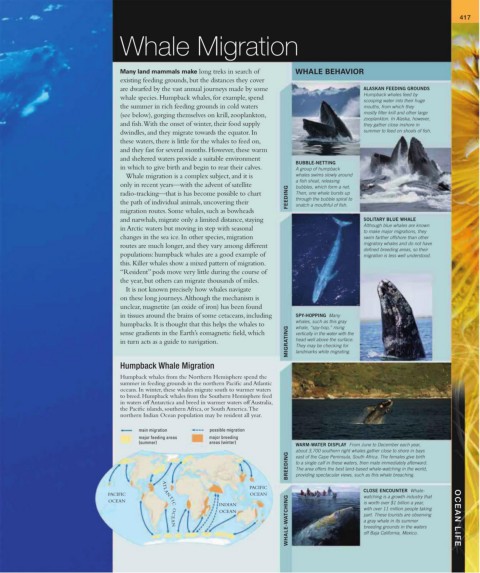
                                     Humpback Whale Migration
                                     Humpback whales from the Northern Hemisphere spend the
                                     summer in feeding grounds in the northern Pacific and Atlantic
                                     oceans. In winter, these whales migrate south to warmer waters
                                     to breed. Humpback whales from the Southern Hemisphere feed
                                     in waters off Antarctica and breed in warmer waters off Australia,
                                     the Pacific islands, southern Africa, or South America. The
                                     northern Indian Ocean population may be resident all year.

                                          main migration       possible migration
                                          major feeding areas   major breeding
                                          (summer)             areas (winter)
                                                                                         WARM-WATER DISPLAY  From June to December each year,
                                                                                         about 3,700 southern right whales gather close to shore in bays
                                                                                       BREEDING  to a single calf in these waters, then mate immediately afterward.
                                                                                         east of the Cape Peninsula, South Africa. The females give birth
                                                                                         The area offers the best land-based whale-watching in the world,
                                                                                         providing spectacular views, such as this whale breaching.
                                                                           PACIFIC
                                                                                                             CLOSE ENCOUNTER  Whale-
                                 PACIFIC                                   OCEAN                             watching is a growth industry that
                                                                                       WHALE-WATCHING        a gray whale in its summer   OCEAN LIFE
                                 OCEAN                                                                       is worth over $1 billion a year,
                                                                  INDIAN
                                                                  OCEAN                                      with over 11 million people taking
                                                                                                             part. These tourists are observing
                                                                                                             breeding grounds in the waters
                                                  ATLANTIC OCEAN
                                                                                                             off Baja California, Mexico.

