


Page 421 - (DK) Ocean - The Definitive Visual Guide
P. 421
419


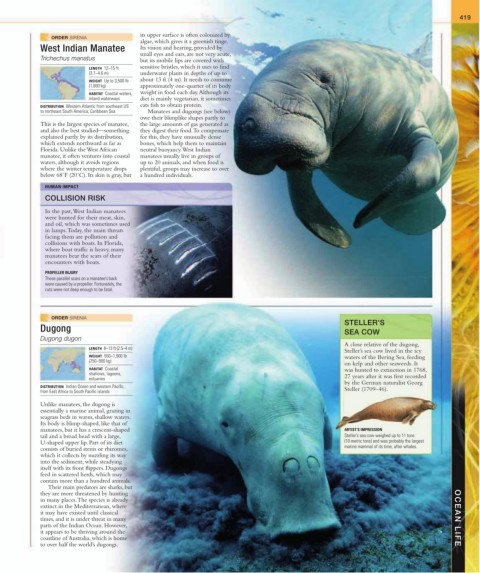
                ORDER SIRENIA              its upper surface is often colonized by
                                           algae, which gives it a greenish tinge.
             West Indian Manatee           Its vision and hearing, provided by
                                           small eyes and ears, are not very acute,
             Trichechus manatus            but its mobile lips are covered with
                           LENGTH  12–15 ft   sensitive bristles, which it uses to find
                           (3.7–4.6 m)     underwater plants in depths of up to
                           WEIGHT  Up to 3,500 lb   about 13 ft (4 m). It needs to consume
                           (1,600 kg)      approximately one-quarter of its body
                           HABITAT  Coastal waters,   weight in food each day. Although its
                           inland waterways    diet is mainly vegetarian, it sometimes
             DISTRIBUTION  Western Atlantic from southeast US   eats fish to obtain protein.
             to northeast South America, Caribbean Sea  Manatees and dugongs (see below)
                                           owe their blimplike shapes partly to
             This is the largest species of manatee,   the large amounts of gas generated as
             and also the best studied—something   they digest their food. To compensate
             explained partly by its distribution,   for this, they have unusually dense
             which extends northward as far as   bones, which help them to maintain
             Florida. Unlike the West African   neutral buoyancy. West Indian
             manatee, it often ventures into coastal   manatees usually live in groups of
             waters, although it avoids regions   up to 20 animals, and when food is
             where the winter temperature drops   plentiful, groups may increase to over
             below 68˚F (20˚C). Its skin is gray, but   a hundred individuals.
              HUMAN IMPACT
              COLLISION RISK

              In the past, West Indian manatees
              were hunted for their meat, skin,
              and oil, which was sometimes used
              in lamps. Today, the main threats
              facing them are pollution and
              collisions with boats. In Florida,
              where boat traffic is heavy, many
              manatees bear the scars of their
              encounters with boats.
              PROPELLER INJURY
              These parallel scars on a manatee’s back
              were caused by a propeller. Fortunately, the
              cuts were not deep enough to be fatal.


                ORDER SIRENIA
                                                                                                        STELLER’S
             Dugong                                                                                     SEA COW
             Dugong dugon
                                                                                                        A close relative of the dugong,
                           LENGTH  8–13 ft (2.5–4 m)
                                                                                                        Steller’s sea cow lived in the icy
                           WEIGHT  550–1,900 lb                                                         waters of the Bering Sea, feeding
                           (250–900 kg)
                                                                                                        on kelp and other seaweeds. It
                           HABITAT  Coastal                                                             was hunted to extinction in 1768,
                           shallows, lagoons,
                           estuaries                                                                    27 years after it was first recorded
                                                                                                        by the German naturalist Georg
             DISTRIBUTION  Indian Ocean and western Pacific,
             from East Africa to South Pacific islands                                                   Steller (1709–46).
             Unlike manatees, the dugong is
             essentially a marine animal, grazing in
             seagrass beds in warm, shallow waters.
             Its body is blimp-shaped, like that of
             manatees, but it has a crescent-shaped                                                     ARTIST’S IMPRESSION
             tail and a broad head with a large,                                                        Steller’s sea cow weighed up to 11 tons
             U-shaped upper lip. Part of its diet                                                       (10 metric tons) and was probably the largest
             consists of buried stems or rhizomes,                                                      marine mammal of its time, after whales.
             which it collects by nuzzling its way
             into the sediment, while steadying
             itself with its front flippers. Dugongs
             feed in scattered herds, which may
             contain more than a hundred animals.
               Their main predators are sharks, but
             they are more threatened by hunting
             in many places. The species is already
             extinct in the Mediterranean, where
             it may have existed until classical
             times, and it is under threat in many                                                                                       OCEAN LIFE
             parts of the Indian Ocean. However,
             it appears to be thriving around the
             coastline of Australia, which is home
             to over half the world’s dugongs.

