


Page 90 - (DK) Ocean - The Definitive Visual Guide
P. 90
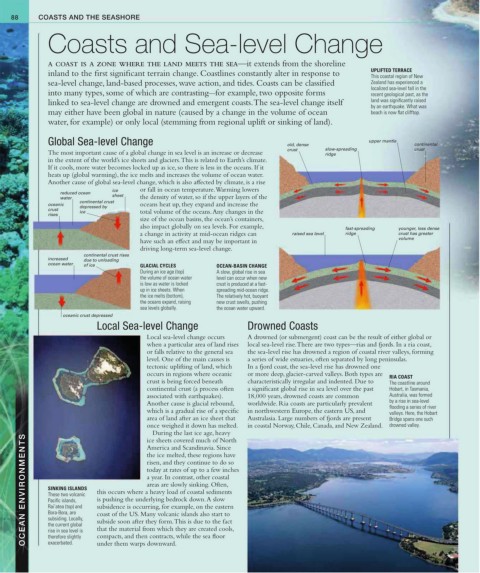
88      COASTS AND THE SEASHORE


               Coasts and Sea-level Change


               A COAST IS A ZONE WHERE THE LAND MEETS THE SEA—it extends from the shoreline
               inland to the first significant terrain change. Coastlines constantly alter in response to      UPLIFTED TERRACE
                                                                                                               This coastal region of New
               sea-level change, land-based processes, wave action, and tides. Coasts can be classified        Zealand has experienced a
                                                                                                               localized sea-level fall in the
               into many types, some of which are contrasting—for example, two opposite forms                  recent geological past, as the
               linked to sea-level change are drowned and emergent coasts. The sea-level change itself         land was significantly raised
                                                                                                               by an earthquake. What was
               may either have been global in nature (caused by a change in the volume of ocean                beach is now flat clifftop.
               water, for example) or only local (stemming from regional uplift or sinking of land).


               Global Sea-level Change                                                 old, dense              upper mantle  continental
                                                                                       crust      slow-spreading            crust
               The most important cause of a global change in sea level is an increase or decrease   ridge
               in the extent of the world’s ice sheets and glaciers. This is related to Earth’s climate.
               If it cools, more water becomes locked up as ice, so there is less in the oceans. If it
               heats up (global warming), the ice melts and increases the volume of ocean water.
               Another cause of global sea-level change, which is also affected by climate, is a rise
                                  ice      or fall in ocean temperature. Warming lowers
                   reduced ocean   sheet
                   water                   the density of water, so if the upper layers of the
                         continental crust
               oceanic   depressed by      oceans heat up, they expand and increase the
               crust     ice               total volume of the oceans. Any changes in the
               rises
                                           size of the ocean basins, the ocean’s containers,
                                           also impact globally on sea levels. For example,             fast-spreading   younger, less dense
                                           a change in activity at mid-ocean ridges can   raised sea level  ridge       crust has greater
                                                                                                                        volume
                                           have such an effect and may be important in
                                           driving long-term sea-level change.
                          continental crust rises
               increased   due to unloading
               ocean water  of ice         GLACIAL CYCLES        OCEAN-BASIN CHANGE
                                           During an ice age (top)    A slow, global rise in sea
                                           the volume of ocean water   level can occur when new
                                           is low as water is locked   crust is produced at a fast-
                                           up in ice sheets. When    spreading mid-ocean ridge.
                                           the ice melts (bottom),    The relatively hot, buoyant
                                           the oceans expand, raising   new crust swells, pushing
                                           sea levels globally.   the ocean water upward.
                    oceanic crust depressed
                              Local Sea-level Change                       Drowned Coasts
                                             Local sea-level change occurs   A drowned (or submergent) coast can be the result of either global or
                                             when a particular area of land rises   local sea-level rise. There are two types—rias and fjords. In a ria coast,
                                             or falls relative to the general sea   the sea-level rise has drowned a region of coastal river valleys, forming
                                             level. One of the main causes is   a series of wide estuaries, often separated by long peninsulas.
                                             tectonic uplifting of land, which   In a fjord coast, the sea-level rise has drowned one
                                             occurs in regions where oceanic   or more deep, glacier-carved valleys. Both types are
                                                                                                                     RIA COAST
                                             crust is being forced beneath   characteristically irregular and indented. Due to    The coastline around
                                             continental crust (a process often   a significant global rise in sea level over the past   Hobart, in Tasmania,
                                             associated with earthquakes).   18,000 years, drowned coasts are common   Australia, was formed
                                             Another cause is glacial rebound,   worldwide. Ria coasts are particularly prevalent    by a rise in sea-level
                                                                                                                     flooding a series of river
                                             which is a gradual rise of a specific   in northwestern Europe, the eastern US, and    valleys. Here, the Hobart
                                             area of land after an ice sheet that   Australasia. Large numbers of fjords are present    Bridge spans one such
                                             once weighed it down has melted.   in coastal Norway, Chile, Canada, and New Zealand.  drowned valley.
                                              During the last ice age, heavy
        OCEAN ENVIRONMENTS  SINKING ISLANDS  this occurs where a heavy load of coastal sediments
                                             ice sheets covered much of North
                                             America and Scandinavia. Since
                                             the ice melted, these regions have
                                             risen, and they continue to do so
                                             today at rates of up to a few inches
                                             a year. In contrast, other coastal
                                             areas are slowly sinking. Often,
               These two volcanic
                              is pushing the underlying bedrock down. A slow
               Pacific islands,
                              subsidence is occurring, for example, on the eastern
               Rai’atea (top) and
               Bora-Bora, are
                              coast of the US. Many volcanic islands also start to
               subsiding. Locally,
                              subside soon after they form. This is due to the fact
               the current global
                              that the material from which they are created cools,
               rise in sea level is
                              compacts, and then contracts, while the sea floor
               therefore slightly
               exacerbated.
                              under them warps downward.

