


Page 91 - (DK) Ocean - The Definitive Visual Guide
P. 91
89


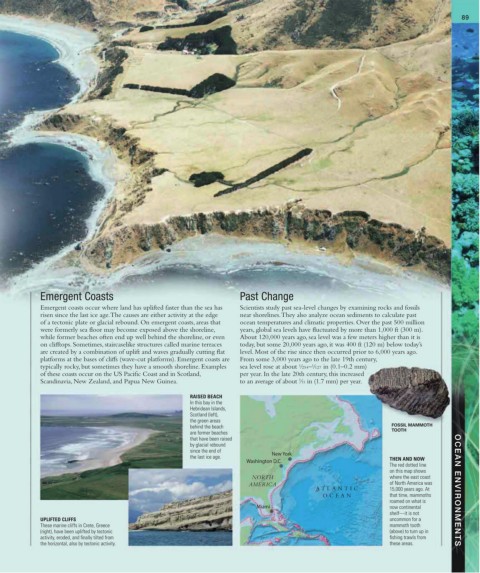
             Emergent Coasts                                            Past Change

             Emergent coasts occur where land has uplifted faster than the sea has   Scientists study past sea-level changes by examining rocks and fossils
             risen since the last ice age. The causes are either activity at the edge    near shorelines. They also analyze ocean sediments to calculate past
             of a tectonic plate or glacial rebound. On emergent coasts, areas that   ocean temperatures and climatic properties. Over the past 500 million
             were formerly sea floor may become exposed above the shoreline,    years, global sea levels have fluctuated by more than 1,000 ft (300 m).
             while former beaches often end up well behind the shoreline, or even   About 120,000 years ago, sea level was a few meters higher than it is
             on clifftops. Sometimes, staircaselike structures called marine terraces    today, but some 20,000 years ago, it was 400 ft (120 m) below today’s
             are created by a combination of uplift and waves gradually cutting flat   level. Most of the rise since then occurred prior to 6,000 years ago.
             platforms at the bases of cliffs (wave-cut platforms). Emergent coasts are   From some 3,000 years ago to the late 19th century,
                                                                                              1
             typically rocky, but sometimes they have a smooth shoreline. Examples   sea level rose at about  / 254– / 127 in (0.1–0.2 mm)
                                                                                          1
             of these coasts occur on the US Pacific Coast and in Scotland,   per year. In the late 20th century, this increased
             Scandinavia, New Zealand, and Papua New Guinea.            to an average of about  ⁄15 in (1.7 mm) per year.
                                                                                          1
                                                          RAISED BEACH
                                                          In this bay in the
                                                          Hebridean Islands,
                                                          Scotland (left),
                                                          the green areas
                                                          behind the beach                                            FOSSIL MAMMOTH
                                                          are former beaches                                          TOOTH
                                                          that have been raised
                                                          by glacial rebound
                                                          since the end of
                                                          the last ice age.       New York
                                                                                                                     THEN AND NOW
                                                                                                                     The red dotted line
                                                                          Washington D.C.
                                                                                                                     on this map shows
                                                                            NORTH                                    where the east coast
                                                                           AMERICA                                   of North America was
                                                                                               A TLANTIC             15,000 years ago. At   OCEAN ENVIRONMENTS
                                                                                                 OCEAN               that time, mammoths
                                                                                                                     roamed on what is
                                                                                                                     now continental
                                                                             Miami
                                                                                                                     shelf—it is not
             UPLIFTED CLIFFS                                                                                         uncommon for a
             These marine cliffs in Crete, Greece                                                                    mammoth tooth
             (right), have been uplifted by tectonic                                                                 (above) to turn up in
             activity, eroded, and finally tilted from                                                                fishing trawls from
             the horizontal, also by tectonic activity.                                                              these areas.

