


Page 95 - (DK) Ocean - The Definitive Visual Guide
P. 95
COASTAL LANDSCAPES             93


             Wave-erosion Coasts                                                            beach         energy concentrated

             Of all the different types of coastal landscape, perhaps the most familiar   part of wave    on headland as wave
                                                                                                          front refracts
                                                                          front opposite
             are wave-eroded cliffed coasts, a type of secondary coast. Wave erosion   beach continues
             on these coasts occurs through two main mechanisms. First, waves hurl   forward                           erosion eventually
             beach material against the cliffs, which abrades the rock. Second, each                                   divides headland
                                                                                                                       into stacks
             wave compresses air within cracks in the rocks, and on reexpansion
             the air shatters the rock. Where waves encounter headlands,
             refraction (bending) of the wave fronts tends to focus their
             erosive energy onto the headlands. At these headlands,
             distinctive features tend to develop in a classic sequence.
             First, deep notches and then sea caves form at the bases
             of  cliffs on each side of the headland. Wave action
             gradually deepens and widens these caves until they
             cut through the headland to form an arch.
             Next, the roof of the arch collapses to leave    part of wave
                                                   front opposite
             an isolated rock pillar called a stack, and   headland slows
             finally the stack is eroded down to a stump.  as it encounters
                                                   shallower water


                                                                                                                             lobe of
                                                                                                                             sediment

                                                                                                                    CONCENTRATION OF
                                                                                                                   WAVE ENERGY
                                                                                                                 When a wave front reaches
                                                                                                               a shore consisting of bays and
                                                                                       wave front
                                                                                       (extended crest       headlands, it refracts in such a
                                                                                       of wave)             way that wave energy tends to be
                                                                                                            concentrated onto the headlands.
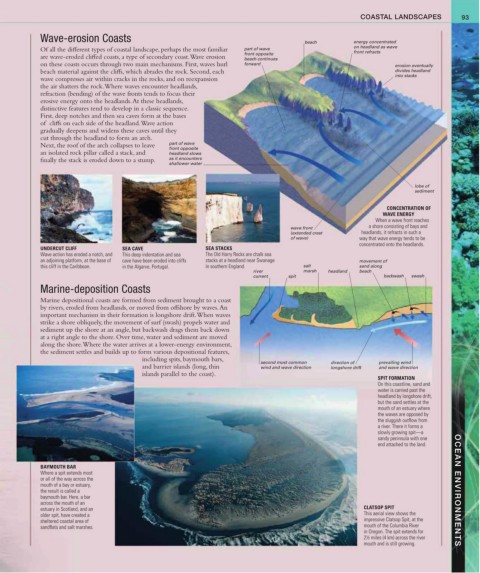
             UNDERCUT CLIFF          SEA CAVE                 SEA STACKS
             Wave action has eroded a notch, and   This deep indentation and sea    The Old Harry Rocks are chalk sea
             an adjoining platform, at the base of   cave have been eroded into cliffs    stacks at a headland near Swanage   movement of
             this cliff in the Caribbean.  in the Algarve, Portugal.  in southern England.  salt            sand along
                                                                            river          marsh   headland  beach
                                                                            current    spit                        backwash  swash
             Marine-deposition Coasts
             Marine depositional coasts are formed from sediment brought to a coast
             by rivers, eroded from headlands, or moved from offshore by waves. An
             important mechanism in their formation is longshore drift. When waves
             strike a shore obliquely, the movement of surf (swash) propels water and
             sediment up the shore at an angle, but backwash drags them back down
             at a right angle to the shore. Over time, water and sediment are moved
             along the shore. Where the water arrives at a lower-energy environment,
             the sediment settles and builds up to form various depositional features,
                                           including spits, baymouth bars,
                                                                               second most common   direction of   prevailing wind
                                           and barrier islands (long, thin     wind and wave direction   longshore drift  and wave direction
                                           islands parallel to the coast).
                                                                                                                  SPIT FORMATION
                                                                                                                  On this coastline, sand and
                                                                                                                  water is carried past the
                                                                                                                  headland by longshore drift,
                                                                                                                  but the sand settles at the
                                                                                                                  mouth of an estuary where
                                                                                                                  the waves are opposed by
                                                                                                                  the sluggish outflow from
                                                                                                                  a river. There it forms a
                                                                                                                  slowly growing spit—a
                                                                                                                  sandy peninsula with one
                                                                                                                  end attached to the land.


             BAYMOUTH BAR
             Where a spit extends most
             or all of the way across the
             mouth of a bay or estuary,
             the result is called a                                                                                                      OCEAN ENVIRONMENTS
             baymouth bar. Here, a bar
             across the mouth of an
             estuary in Scotland, and an                                                                     CLATSOP SPIT
             older spit, have created a                                                                      This aerial view shows the
             sheltered coastal area of                                                                       impressive Clatsop Spit, at the
             sandflats and salt marshes.                                                                      mouth of the Columbia River
                                                                                                             in Oregon. The spit extends for
                                                                                                             2½ miles (4 km) across the river
                                                                                                             mouth and is still growing.

