


Page 93 - (DK) Ocean - The Definitive Visual Guide
P. 93
Global Warming                                                                                        91


                                     and Sea-level Rise


                                     The measurement of global sea-level change is
                                                                                         EFFECTS OF GLOBAL WARMING
                                     complex and, until satellite-based techniques were
                                     introduced in 1992, was somewhat imprecise. During
                                     the 1980s, a consensus emerged that sea level had
                                                    1
                                                 1
                                     been rising at  / 32– / 8 in (1–3 mm) per year since
                                     1900, whereas the new satellite techniques indicate
                                                          1
                                     a current average rise of  / 8 in (3 mm) per year. Since
                                     1900, there has also been a rise in the temperature of
                                     Earth’s atmosphere and oceans (global warming) of
                                     about 1.44˚F (0.8˚C). There are two plausible
                                     mechanisms by which the temperature rise might be
                                     linked to the sea-level rise: first, through melting of
                                     glaciers and ice sheets, which increases the amount of
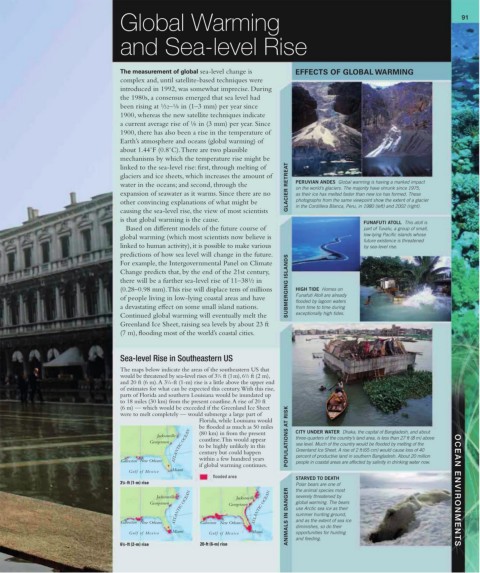
                                     water in the oceans; and second, through the      GLACIER RETREAT  PERUVIAN ANDES  Global warming is having a marked impact
                                                                                         on the world’s glaciers. The majority have shrunk since 1975,
                                     expansion of seawater as it warms. Since there are no   as their ice has melted faster than new ice has formed. These
                                     other convincing explanations of what might be      photographs from the same viewpoint show the extent of a glacier
                                                                                         in the Cordillera Blanca, Peru, in 1980 (left) and 2002 (right).
                                     causing the sea-level rise, the view of most scientists
                                     is that global warming is the cause.
                                                                                                             FUNAFUTI ATOLL  This atoll is
                                      Based on different models of the future course of                      part of Tuvalu, a group of small,
                                                                                                             low-lying Pacific islands whose
                                     global warming (which most scientists now believe is
                                                                                                             future existence is threatened
                                     linked to human activity), it is possible to make various               by sea-level rise.
                                     predictions of how sea level will change in the future.
                                     For example, the Intergovernmental Panel on Climate
                                     Change predicts that, by the end of the 21st century,
                                     there will be a further sea-level rise of 11–38 / 2 in
                                                                           1
                                     (0.28–0.98 mm). This rise will displace tens of millions   SUBMERGING ISLANDS  HIGH TIDE  Homes on
                                     of people living in low-lying coastal areas and have    Funafuti Atoll are already
                                                                                         flooded by lagoon waters
                                     a devastating effect on some small island nations.   from time to time during
                                     Continued global warming will eventually melt the   exceptionally high tides.
                                     Greenland Ice Sheet, raising sea levels by about 23 ft
                                     (7 m), flooding most of the world’s coastal cities.


                                     Sea-level Rise in Southeastern US
                                     The maps below indicate the areas of the southeastern US that
                                                                          1
                                                                    1
                                     would be threatened by sea-level rises of 3/4 ft (1 m), 6/2 ft (2 m),
                                                     1
                                     and 20 ft (6 m). A 3/4-ft (1-m) rise is a little above the upper end
                                     of estimates for what can be expected this century. With this rise,
                                     parts of Florida and southern Louisiana would be inundated up
                                     to 18 miles (30 km) from the present coastline. A rise of 20 ft
                                     (6 m) — which would be exceeded if the Greenland Ice Sheet
                                     were to melt completely — would submerge a large part of
                                                            Florida, while Louisiana would
                                                            be flooded as much as 50 miles
                                                     ATLANTIC OCEAN  to be highly unlikely in this   Greenland Ice Sheet. A rise of 2 ft (65 cm) would cause loss of 40
                                                Jacksonville  (80 km) in from the present   POPULATIONS AT RISK  CITY UNDER WATER  Dhaka, the capital of Bangladesh, and about
                                                                                         three-quarters of the country’s land area, is less than 27 ft (8 m) above
                                             Georgetown     coastline. This would appear    sea level. Much of the country would be flooded by melting of the
                                                            century but could happen
                                     Galveston  New Orleans  within a few hundred years    percent of productive land in southern Bangladesh. About 20 million
                                                                                         people in coastal areas are affected by salinity in drinking water now.
                                                            if global warming continues.
                                                    Miami
                                       Gulf of Mexico
                                                                flooded area
                                                                                         STARVED TO DEATH
                                     3 1 /4-ft (1-m) rise
                                                                                         Polar bears are one of                          OCEAN ENVIRONMENTS
                                                                                         the animal species most
                                                     ATLANTIC OCEAN          ATLANTIC OCEAN  use Arctic sea ice as their
                                                Jacksonville           Jacksonville      severely threatened by
                                              Georgetown             Georgetown          global warming. The bears
                                                                                         summer hunting ground,
                                     Galveston  New Orleans  Galveston  New Orleans    ANIMALS IN DANGER  and as the extent of sea ice
                                                                                         diminishes, so do their
                                                    Miami                   Miami
                                       Gulf of Mexico          Gulf of Mexico            opportunities for hunting
                                     6 1 /2-ft (2-m) rise    20-ft (6-m) rise            and feeding.

