


Page 50 - AirForces - Monthly (February 2020)
P. 50
Force
              Report                    Peruvian Air Force


                                                                    It was a conflict which, for the   Workshops) were established
                                                                   most part, was fought in the skies   at Las Palmas to provide repair
                                                                   above the Amazon rainforest. The   and maintenance services for
                                                                   CAP, equipped with a small force of   the growing number of aircraft
                                                                   biplanes, including ten Vought O2U-  in Peruvian military service.
                                                                   1E Corsair and six Douglas O-38   In early 1935, as an extension of
                                                                   observation/attack aircraft and   the CAP reorganisation process,
                                                                   three Curtiss 35A Hawk II fighters,   military air bases and airfields
                                                                   faced a numerically superior   were opened at strategic locations
                                                                   Colombian air arm reinforced   across the country, at that time
                                                                   with experienced crews, including   divided into five air regions,
                                                                   German World War One veterans.   each provided with a main
              Su-25 serial 070 (c/n 10058) over the Pacific. In early 2017, Rosoboronexport
              signed a contract for the overhaul of the ‘Frogfoot’ fleet. To date, five single-  Nevertheless, the CAP crews fought  military air base and a number
              seaters and five two-seaters have undergone the work, which involves a limited   bravely during the nine months   of support airfields, allowing
              upgrade. The remaining aircraft are now in storage.   of this almost-forgotten conflict.  the flexible detachment of air
                                                                    With a ceasefire with Colombia   units stationed in the region.
                                                                   agreed in May 1933, the CAP   The first airfield to be opened
                                                                   underwent an extensive expansion   was Arequipa, located in the city
                                                                   and reorganisation programme   of the same name, around 620
                                                                   the following summer, including   miles (1,000km) south of Lima, on
                                                                   improving and restructuring   April 26, 1935. This was followed
                                                                   the Escuela de Aviación Militar   by Pucallpa airfield on September
                                                                   (EAM, Military Aviation School).   28 the same year; the Escuela
                                                                   Experience gained during the   de Vuelo de Altura (High-Altitude
                                                                   conflict with Colombia led to several  Flight School) at Huancayo on
                                                                   changes in aircrew training, the   April 19, 1936; the ‘Mayor Guillermo
                                                                   most important being the division   Protzel del Castillo’ air base at Vítor,
                                                                   of training for cadet and officer   Arequipa province, on June 18, 1936,
                                                                   students. While the former covered   and, finally, the ‘Teniente Coronel
                                                                   the training of civilians admitted to   Pedro Ruiz Gallo’ air base at
                                                                   the EAM via the regular process,   Chiclayo on September 21 that year.
                                                                   the latter was intended to improve   On October 13, 1936, a secret
                                                                   the flight training skills of officers   set of regulations under the name
                                                                   from the Army’s Military Aviation   Estrategia y Logística del Cuerpo
                                                                   Service and Naval Aviation Corps.  Aeronáutico del Perú (CAP
                                                                    The same year, by means of   Strategy and Logistics) was
                                                                   Supreme Decree No 5, dated June   issued and approved via
                                                                   13, 1933, the Talleres Centrales   Supreme Decree.
              1                                                    de Aviación (Aviation Central   This set


              2
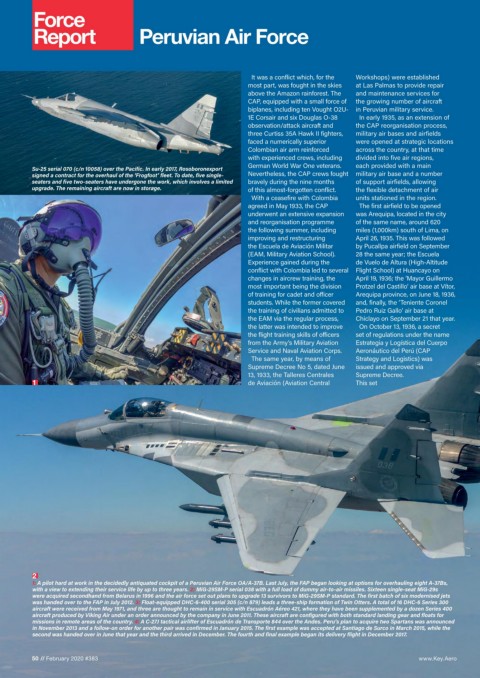
              1: A pilot hard at work in the decidedly antiquated cockpit of a Peruvian Air Force OA/A-37B. Last July, the FAP began looking at options for overhauling eight A-37Bs,
              with a view to extending their service life by up to three years. 2: MiG-29SM-P serial 038 with a full load of dummy air-to-air missiles. Sixteen single-seat MiG-29s
              were acquired secondhand from Belarus in 1996 and the air force set out plans to upgrade 13 survivors to MiG-29SM-P standard. The first batch of six modernised jets
              was handed over to the FAP in July 2012. 3: Float-equipped DHC-6-400 serial 305 (c/n 879) leads a three-ship formation of Twin Otters. A total of 16 DHC-6 Series 300
              aircraft were received from May 1971, and three are thought to remain in service with Escuadrón Aéreo 421, where they have been supplemented by a dozen Series 400
              aircraft produced by Viking Air under an order announced by the company in June 2011. These aircraft are configured with both standard landing gear and floats for
              missions in remote areas of the country. 4: A C-27J tactical airlifter of Escuadrón de Transporte 844 over the Andes. Peru’s plan to acquire two Spartans was announced
              in November 2013 and a follow-on order for another pair was confirmed in January 2015. The first example was accepted at Santiago de Surco in March 2015, while the
              second was handed over in June that year and the third arrived in December. The fourth and final example began its delivery flight in December 2017.


              50 // February 2020 #383                                                                        www.Key.Aero


                                                                                                                06/01/2020   11:47:00
        48-55 PeruAF AFM Feb2020.indd   50
        48-55 PeruAF AFM Feb2020.indd   50                                                                      06/01/2020   11:47:00

