


Page 55 - AirForces - Monthly (February 2020)
P. 55
airforcesintel.com


           Mirage 5P and Su-22 fighter-
           bombers undertook air superiority,
           combat air patrol (CAP) and
           close-support missions, while
           Cessna A-37B-equipped ground-
           attack units performed the close-
           support role against Ecuadorian
           positions inside Peruvian territory.
           Notably, FAP units, like their CAP
           predecessors in 1941, carried
           out aerial assaults on occupied
           positions, this time employing
           helicopters to carry troops to
           their objectives, enabling ground
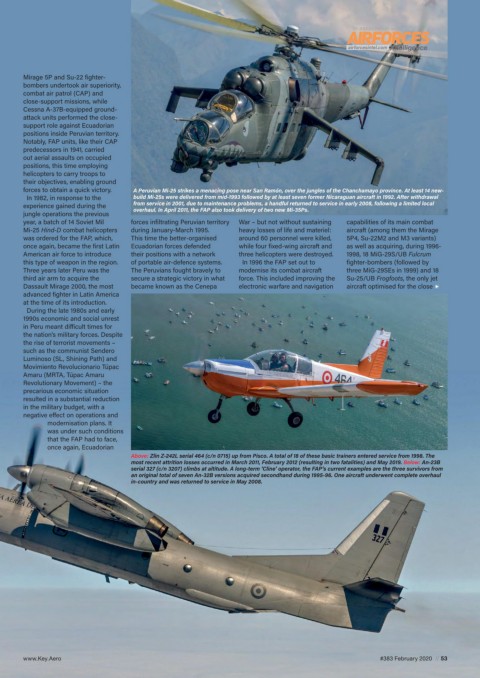
           forces to obtain a quick victory.  A Peruvian Mi-25 strikes a menacing pose near San Ramón, over the jungles of the Chanchamayo province. At least 14 new-
            In 1982, in response to the   build Mi-25s were delivered from mid-1993 followed by at least seven former Nicaraguan aircraft in 1992. After withdrawal
           experience gained during the   from service in 2001, due to maintenance problems, a handful returned to service in early 2008, following a limited local
           jungle operations the previous   overhaul. In April 2011, the FAP also took delivery of two new Mi-35Ps.
           year, a batch of 14 Soviet Mil   forces infiltrating Peruvian territory   War – but not without sustaining   capabilities of its main combat
           Mi-25 Hind-D combat helicopters   during January-March 1995.   heavy losses of life and materiel:   aircraft (among them the Mirage
           was ordered for the FAP, which,   This time the better-organised   around 60 personnel were killed,   5P4, Su-22M2 and M3 variants)
           once again, became the first Latin   Ecuadorian forces defended   while four fixed-wing aircraft and   as well as acquiring, during 1996-
           American air force to introduce   their positions with a network   three helicopters were destroyed.  1998, 18 MiG-29S/UB Fulcrum
           this type of weapon in the region.   of portable air-defence systems.   In 1996 the FAP set out to   fighter-bombers (followed by
           Three years later Peru was the   The Peruvians fought bravely to   modernise its combat aircraft   three MiG-29SEs in 1999) and 18
           third air arm to acquire the   secure a strategic victory in what   force. This included improving the   Su-25/UB Frogfoots, the only jet
           Dassault Mirage 2000, the most   became known as the Cenepa   electronic warfare and navigation   aircraft optimised for the close
           advanced fighter in Latin America
           at the time of its introduction.
            During the late 1980s and early
           1990s economic and social unrest
           in Peru meant difficult times for
           the nation’s military forces. Despite
           the rise of terrorist movements –
           such as the communist Sendero
           Luminoso (SL, Shining Path) and
           Movimiento Revolucionario Túpac
           Amaru (MRTA, Túpac Amaru
           Revolutionary Movement) – the
           precarious economic situation
           resulted in a substantial reduction
           in the military budget, with a
           negative effect on operations and
                 modernisation plans. It
                 was under such conditions
                 that the FAP had to face,
                 once again, Ecuadorian
                                      Above: Zlin Z-242L serial 464 (c/n 0715) up from Pisco. A total of 18 of these basic trainers entered service from 1998. The
                                      most recent attrition losses occurred in March 2011, February 2012 (resulting in two fatalities) and May 2019. Below: An-23B
                                      serial 327 (c/n 3207) climbs at altitude. A long-term ‘Cline’ operator, the FAP’s current examples are the three survivors from
                                      an original total of seven An-32B versions acquired secondhand during 1995-96. One aircraft underwent complete overhaul
                                      in-country and was returned to service in May 2008.


           www.Key.Aero                                                                             #383 February 2020  //  53


                                                                                                                06/01/2020   11:48:38
        48-55 PeruAF AFM Feb2020.indd   53                                                                      06/01/2020   11:48:38
        48-55 PeruAF AFM Feb2020.indd   53

