


Page 119 - (DK Eyewitness) Travel Guide - Krakow
P. 119
OLD QU AR TER 117
forward in 1872. Jan Zawiejski interior is extremely well
submitted the design and was preserved and the nave
put in charge of the works impresses with its intricate
which were to be financed pattern of vaulting ribs,
entirely through donations. supported on a single, round
The foundation stone was pillar. Among its furnishings,
laid in 1891, and the theatre the Gothic font made in 1423
opened in 1893. Zawiejski by Jan Freudenthal and the
designed an opulent building late Renaissance triptych in
in which vernacular elements, the Węgrzyn Chapel (next to
such as the parapet inspired the porch) are of particular
by the Cloth Hall, and foreign interest. There are also various
influences were blended into Baroque altars and stalls, as
an eclectic whole. Allegorical well as a number of memorial
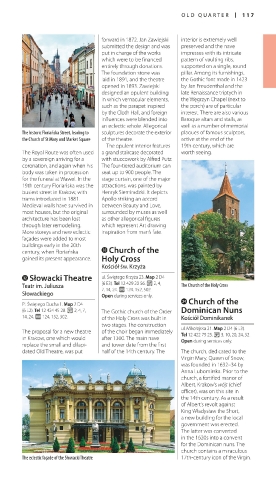
The historic Floriańska Street, leading to sculptures decorate the exterior plaques of famous sculptors,
the Church of St Mary and Market Square of the theatre. active at the end of the
The opulent interior features 19th century, which are
The Royal Route was often used a grand staircase decorated worth seeing.
by a sovereign arriving for a with stuccowork by Alfred Putz.
coronation, and again when his The fourtiered auditorium can
body was taken in procession seat up to 900 people. The
for the funeral at Wawel. In the stage curtain, one of the major
19th century Floriańska was the attractions, was painted by
busiest street in Krakow, with Henryk Siemiradzki. It depicts
trams introduced in 1881. Apollo striking an accord
Medieval walls have survived in between Beauty and Love,
most houses, but the original surrounded by muses as well
architecture has been lost as other allegorical figures
through later remodelling. which represent Art drawing
More storeys and new eclectic inspiration from man’s fate.
façades were added to most
buildings early in the 20th
century, when Floriańska vChurch of the
gained its present appearance. Holy Cross
Kościół św. Krzyża
cSłowacki Theatre ul. Świętego Krzyża 23. Map 2 D4
Teatr im. Juliusza (6 E3). Tel 12 429 20 56. v 2, 4, The Church of the Holy Cross
7, 14, 24. @ 124, 152, 502.
Słowackiego Open during services only.
Pl. Świętego Ducha 1. Map 2 D4 bChurch of the
(6 E2). Tel 12 424 45 28. v 2, 4, 7, The Gothic church of the Order Dominican Nuns
14, 24. @ 124, 152, 502. of the Holy Cross was built in Kościół Dominikanek
two stages. The construction
The proposal for a new theatre of the choir began immediately ul. Mikołajska 21. Map 2 D4 (6 E3).
Tel 12 422 79 25. v 3, 10, 20, 24, 52.
in Krakow, one which would after 1300. The main nave Open during services only.
replace the small and dilapi and tower date from the first
dated Old Theatre, was put half of the 14th century. The The church, dedicated to the
Virgin Mary, Queen of Snow,
was founded in 1632–34 by
Anna Lubomirska. Prior to the
church, a fortified manor of
Albert, Krakow’s wójt (chief wójt (chief wójt
officer), was on this site in
the 14th century. As a result
of Albert’s revolt against
King Władysław the Short,
a new building for the local
government was erected.
The latter was converted
in the 1620s into a convent
for the Dominican nuns. The
church contains a miraculous
The eclectic façade of the Słowacki Theatre 17thcentury icon of the Virgin.

