


Page 151 - (DK Eyewitness) Travel Guide - Krakow
P. 151
PIASEK AND NOWY ŚWIA T 149
the tomb of the Confederates rBłonia Fields of the great artist and
of Bar who fell in a rebellion Map 1 A5. @ 114, 134, 152, 164, 173, playwright of the so-called
against the Russians in 1768. 179, 192, 292. v 15, 18, 20. Young Poland movement
Between 1712 and 1719 an (Polish Modernism). The
external Loreto Chapel was built The Błonia Fields formed part sculptor, Marian Konieczny,
to a design by Kacper Bażanka; of the grounds owned by the depicted Stanisław Wyspiański
this is linked to the church Convent of Premonstraten- surrounded by the characters
through a cloister. It houses a sian (Norbertine) Nuns in from two of his plays, The
Neo-Classical altar with a mirac- Zwierzyniec and were originally Wedding and November Night.
ulous statue of the Madonna of used as pastures. In 1366 the The monument was badly
Loreto and a beautiful tabernacle, nuns made a rather bad deal received and prompted
also designed by Bażanka. An with the city’s authorities and unfavourable interpretations.
animated Christmas crib is exchanged Błonia for a house
erected here every year, feat- in Floriańska Street. The house
uring historic Polish characters. proved to be unprofitable and yNational Museum
was eventually destroyed by in Krakow, Main
fire. This gave rise to a joke Building
about the nuns who had
exchanged pastures for a See pp150–51.
bonfire. For centuries the nuns
tried in vain to regain the land
but the Błonia Fields remain the uSchool of
property of the City of Krakow. Chemistry
Błonia were used in the past Zespół Szkół Chemicznych
as a venue for mass religious
and national celebrations: the ul. Krupnicza 44. Map 1 A4 (5 A2).
first football match in Krakow Tel 12 422 32 20. @ 114, 164, 169,
took place here in 1894 and 173, 179. Closed to the public.
Pope John Paul II said a Holy
Mass here on four occasions. In 1834 the Institute
Today it is a wildlife sanctuary of Technology was
in the centre of Krakow and a established in
popular place for recreation. Krakow, funded by
the bequest of the
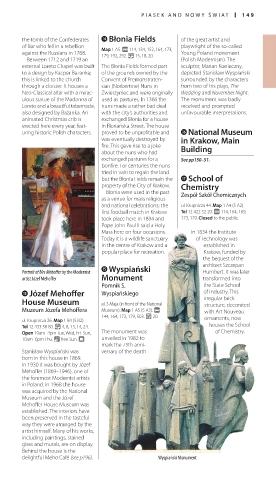
tWyspiański architect Szczepan
P P Portrait of Mrs Mehoffer by the Modernist ortrait of Mrs Mehoffer by the Modernist ortrait of Mrs Mehoffer Humbert. It was later
artist Józef Mehoffer Monument transformed into
Pomnik S. the State School
eJózef Mehoffer Wyspiańskiego of Industry. This
House Museum al. 3 Maja (in front of the National irregular brick
structure, decorated
Muzeum Józefa Mehoffera Museum). Map 1 A5 (5 A3). @ with Art Nouveau
144, 164, 173, 179, 503. v 20. ornaments, now
ul. Krupnicza 26. Map 1 B4 (5 B2).
Tel 12 433 58 80. v 4, 8, 13, 14, 24. houses the School
Open 10am–4pm Tue, Wed, Fri–Sun, The monument was of Chemistry.
10am–6pm Thu. & free Sun. - unveiled in 1982 to
mark the 75th anni-
Stanisław Wyspiański was versary of the death
born in this house in 1869.
In 1930 it was bought by Józef
Mehoffer (1869–1946), one of
the foremost Modernist artists
in Poland. In 1968 the house
was acquired by the National
Museum and the Józef
Mehoffer House Museum was
established. The interiors have
been preserved in the tasteful
way they were arranged by the
artist himself. Many of his works,
including paintings, stained
glass and murals, are on display.
Behind the house is the
delightful Meho Café (see p196). Wyspiański Monument

