


Page 159 - (DK Eyewitness) Travel Guide - Krakow
P. 159
FUR THER AFIELD 157
to World War II. The museum by a small portico supported
has a modern central pavilion by columns, make this building
which features one of the characteristic of Polish archi-
best collections of early tecture of this type. Both
20th-century aircraft. The manors are set in a pictur-
collection consists of more esquely landscaped park,
than 200 aircraft, including laid out in the 19th century.
pre-war Polish fighter planes, Next to Branice is the village
Spitfires, German Albatrosses of Ruszcza with the Church
and Soviet Kakaruzniks. Also of St George. The church
in the museum are 22 rare was built around 1420 by the
aeroplanes that were once Royal Master of the Pantry,
part of Hermann Göring’s Wierzbięta of Branice. His
personal collection. In Gothic memorial plaque and
addition, there are several the Baroque high altar are
displays in neighbouring both of interest.
hangars and a large open-
air section.
5Niepołomice
4Branice 24 km (15 miles) southeast of Krakow.
@ minibus from ul. Worcella
12 km (7.5 miles) east from Krakow. opposite Galeria Krakowska.
@ 131. v 10 to Pleszów terminus, Church: Open 7am–6pm daily.
then bus. Manor: Branice 131. Castle: Tel 12 281 30 11. Open Façade of the castle in Niepołomice, a
May–Sep: 10am–6pm; Oct–Apr residence of Polish kings
Branice is situated not far 10am–5pm. &
from Niepołomice and is and sculptor Santi Gucci in
worth visiting for its two The royal grounds in the Mannerist style. In the
manors which exemplify Niepołomice, situated on Chapel of the Lubomirski
the small-scale residential the outskirts of a vast wood- family, built in 1640, wall
architecture of the gentry of land, were much favoured paintings depicting scenes
Lesser Poland. The Old Manor, by Polish kings. They came from the life of St Carlo
later converted into a store, here to rest and hunt, and Borromeo are of interest.
was built around 1603 for developed magnificent Late-Baroque altars were
the Castellan of Żarnów, buildings in the town they added in the 18th century.
Jan Branicki, by an architect owned. The Gothic church The hunting lodge in
from the circle of Santi Gucci. in Niepołomice was founded Niepołomice was originally
The exterior of the manor is by King Kazimierz the Great built by Kazimierz the Great.
decorated with sgraffiti and between 1350 and 1358. It was transformed by Zygmunt
topped with a parapet. The Like other sacred buildings August into a magnificent
doors and fireplace inside founded by this sovereign, residence. The new castle was
are lavishly decorated with this church had two aisles constructed between 1550
imaginative Mannerist orna- separated by pillars. and 1571. Its regular plan
ments carved in stone. It was later rebuilt in the and the central, square
The New Manor was built Baroque style. Fragments of courtyard differ from other
in the early 19th century in the rich stone decoration from royal Renaissance houses
Classical style. Its high hipped the interior of the medieval in Poland. In 1637 massive
roof, and the entrance marked church have survived and are stone arcades were added
displayed in the Old Sacristy. to the courtyard. Part of the
Outstanding Gothic paintings castle is used to house the
made between 1370 and Museum of Hunting.
1375 by an Italian master, The dense forest (Puszcza
commissioned by Princess Niepołomicka), a favourite
Elźbieta (daughter of hunting ground of Polish
Władysław the Short), are kings, stretches right behind
also in the Old Sacristy. the town. Brown bears, bison,
Next to the church are two lynx, wildcat and deer are
mausolea of noble families, known to have inhabited it.
both in the form of chapels The forest is not so magni-
covered by domes. Built in ficent as it used to be,
1596, the Branicki Chapel is though wild areas have
the earlier of the two. It been preserved, including
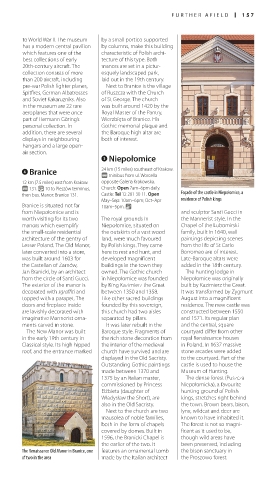
The Renaissance Old Manor in Branice, one features an ornamental tomb the bison sanctuary in
of two in the area made by the Italian architect the Proszowo forest.

