


Page 24 - (DK Eyewitness) Travel Guide - Krakow
P. 24
22 INTRODUCING KR AK OW
Krakow’s Origins
Krakow is one of the oldest cities in Poland. Archaeological
findings provide evidence of a Palaeolithic settlement, as
well as those from the Neolithic period, and the Bronze and
Iron Ages. The Celtic people and invaders from the east,
namely the Scythians and Huns, also left important artifacts.
In the early centuries AD Krakow and Lesser Poland bordered
and traded with the Roman Empire. Written accounts date Extent of the City
only from the 9th century and pertain to the Vistulan settlers AD 1000 Today
who, by the end of the same century, came under the rule
of the Great Moravian Empire. Polish rulers from the House
of Piast gained control over the region towards the end of
the rule of Mieszko I (around 992).
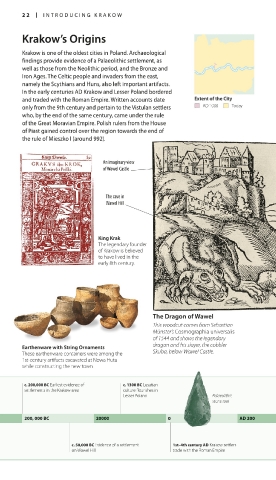
An imaginary view
of Wawel Castle
The cave in
Wawel Hill
King Krak
The legendary founder
of Krakow is believed
to have lived in the
early 8th century.
The Dragon of Wawel
This woodcut comes from Sebastian
Münster’s Cosmographia universalis
of 1544 and shows the legendary
Earthenware with String Ornaments dragon and his slayer, the cobbler
These earthenware containers were among the Skuba, below Wawel Castle.
1st-century artifacts excavated at Nowa Huta
while constructing the new town.
c. 200,000 BC Earliest evidence of c. 1300 BC Lusatian
settlements in the Krakow area culture flourishes in
Lesser Poland Palaeolithic
stone tool
200, 000 BC 20000 0 AD 200
c. 50,000 BC Evidence of a settlement 1st–4th century AD Krakow settlers
on Wawel Hill trade with the Roman Empire

