


Page 27 - (DK Eyewitness) Travel Guide - Krakow
P. 27
THE HIST OR Y OF KR AK OW 25
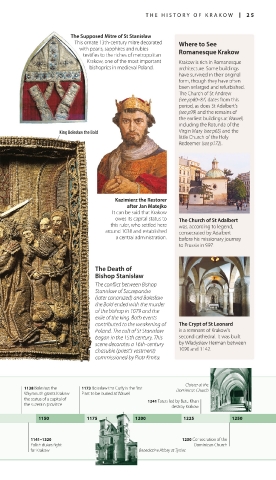
The Supposed Mitre of St Stanisław
This ornate 13th-century mitre decorated Where to See
with pearls, sapphires and rubies Romanesque Krakow
testifies to the riches of metropolitan
Krakow, one of the most important Krakow is rich in Romanesque
bishoprics in medieval Poland. architecture. Some buildings
have survived in their original
form, though they have often
been enlarged and refurbished.
The Church of St Andrew
(see pp80–81) dates from this
period, as does St Adalbert’s
(see p99) and the remains of
the earliest buildings at Wawel,
including the Rotunda of the
King Bolesław the Bold Virgin Mary (see p65) and the
little Church of the Holy
Redeemer (see p172).
Kazimierz the Restorer
after Jan Matejko
It can be said that Krakow
owes its capital status to The Church of St Adalbert
this ruler, who settled here was, according to legend,
around 1038 and established consecrated by Adalbert
a central administration. before his missionary journey
to Prussia in 997.
The Death of
Bishop Stanisław
The conflict between Bishop
Stanisław of Szczepanów
(later canonized) and Bolesław
the Bold ended with the murder
of the bishop in 1079 and the
exile of the king. Both events
contributed to the weakening of The Crypt of St Leonard
Poland. The cult of St Stanisław is a remnant of Krakow’s
began in the 15th century. This second cathedral. It was built
scene decorates a 16th-century by Władysław Herman between
chasuble (priest’s vestment) 1090 and 1142.
commissioned by Piotr Kmita.
Cloister at the
1138 Bolesław the 1173 Bolesław the Curly is the first Dominican Church
Wrymouth grants Krakow Piast to be buried at Wawel
the status of a capital of 1241 Tatars led by Batu Khan
the suzerain province
destroy Krakow
1150 1175 1200 1225 1250
1141–1320 1250 Consecration of the
Polish dukes fight Dominican Church
for Krakow Benedictine Abbey at Tyniec

