


Page 26 - (DK Eyewitness) Travel Guide - Krakow
P. 26
24 INTRODUCING KR AK OW
Krakow in the Early
Middle Ages
Following the establishment of a bishopric in 1000 and
the construction of the cathedral, Krakow became one of
the most important centres of the Polish state. After the
destruction of other centres in Lesser Poland (Małopolska)
by the Czechs in the first half of the 11th century, Kazimierz Extent of the City
the Restorer and his successors made Krakow their main 1253 Today
seat. Following the death of Bolesław the Wrymouth Poland
was divided into duchies, and the Dukes of Krakow gained
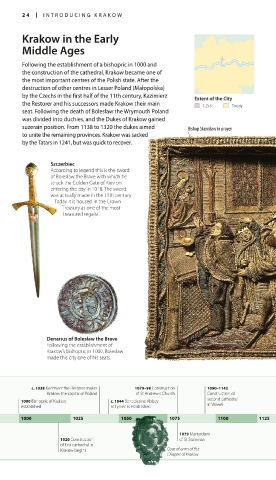
suzerain position. From 1138 to 1320 the dukes aimed Bishop Stanisław in prayer
to unite the remaining provinces. Krakow was sacked
by the Tatars in 1241, but was quick to recover.
Szczerbiec
According to legend this is the sword
of Bolesław the Brave with which he
struck the Golden Gate of Kiev on
entering the city in 1018. The sword
was actually made in the 13th century.
Today it is housed in the Crown
Treasury as one of the most
treasured regalia.
Denarius of Bolesław the Brave
Following the establishment of
Krakow’s bishopric in 1000, Bolesław
made this city one of his seats.
c. 1038 Kazimierz the Restorer makes 1079–98 Construction 1090–1142
Krakow the capital of Poland of St Andrew’s Church Construction of
second cathedral
1000 Bishopric of Krakow c. 1044 Benedictine Abbey
established at Tyniec is established at Wawel
1000 1025 1050 1075 1100 1125
1079 Martyrdom
1020 Construction of St Stanisław
of first cathedral in
Krakow begins Coat of arms of the
Chapter of Krakow

