


Page 88 - (DK Eyewitness) Travel Guide - Krakow
P. 88
86 KR AK OW AREA B Y AREA
y Franciscan Church
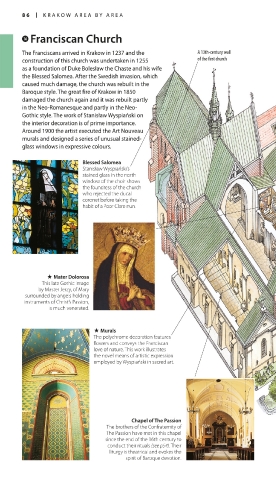
The Franciscans arrived in Krakow in 1237 and the A 13th-century wall
construction of this church was undertaken in 1255 of the first church
as a foundation of Duke Bolesław the Chaste and his wife
the Blessed Salomea. After the Swedish invasion, which
caused much damage, the church was rebuilt in the
Baroque style. The great fire of Krakow in 1850
damaged the church again and it was rebuilt partly
in the Neo-Romanesque and partly in the Neo-
Gothic style. The work of Stanisław Wyspiański on
the interior decoration is of prime importance.
Around 1900 the artist executed the Art Nouveau
murals and designed a series of unusual stained-
glass windows in expressive colours.
Blessed Salomea
Stanisław Wyspiański’s
stained glass in the north
window of the choir shows
the foundress of the church
who rejected the ducal
coronet before taking the
habit of a Poor Clare nun.
. Mater Dolorosa
This late Gothic image
by Master Jerzy, of Mary
surrounded by angels holding
instruments of Christ’s Passion,
is much venerated.
. Murals
The polychrome decoration features
flowers and conveys the Franciscan
love of nature. This work illustrates
the novel means of artistic expression
employed by Wyspiański in sacred art.
Chapel of The Passion
The brothers of the Confraternity of
The Passion have met in this chapel
since the end of the 16th century to
conduct their rituals (see p54). Their
liturgy is theatrical and evokes the
spirit of Baroque devotion.

