


Page 87 - (DK Eyewitness) Travel Guide - Krakow
P. 87
OK ÓŁ AND STR ADOM QU AR TERS 85
wStatue of rArchaeological
Piotr Skarga Museum
Posąg Piotra Skargi Muzeum Archeologiczne
Plac Marii Magdaleny. Map 1 C5 ul. Poselska 3. Map 1 C5 (6 D4). Tel 12
(6 D4). v 1, 6, 8, 10, 13, 18, 20. 422 71 00. @ 504. v 1, 6, 8, 10, 13,
18, 20. Open 9am–3pm Mon, Wed &
Dominating the small piazza Fri; 9am–6pm Tue & Thu; 11am–4pm
that connects Kanonicza with Sun (Jul & Aug: 11am– 6pm Mon-Fri,
Grodzka is a modern statue of 10am–3pm Sun). & free on Sun.
the leading Polish Jesuit Piotr
Skarga (1536–1612). Skarga was Begun in 1850 and known then
a powerful orator and preacher, as the Museum of Antiquities,
something captured admirably the Archaeological Museum is
in this animated sculpture by housed in the former Friary
Czesław Dźwigaj. of the Discalced Carmelites,
founded in 1606. Its collection
includes artifacts that tell the
eCricoteka earliest history of the Lesser
Poland region. The statue of the
ul. Kanonicza 5. Map 1 C5 (6 D4).
v 1, 6, 8, 10, 13, 18, 20. idol Światowid, salvaged from
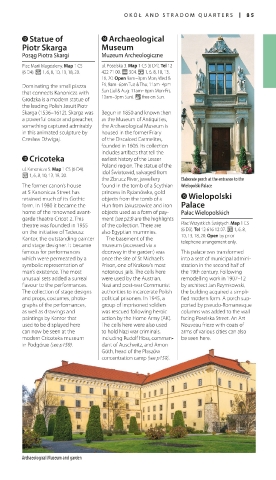
the Zbrucz River, jewellery Elaborate porch at the entrance to the
The former canon’s house found in the tomb of a Scythian Wielopolski Palace
at 5 Kanonicza Street has princess in Ryżanówka, gold tWielopolski
retained much of its Gothic objects from the tomb of a
form. In 1980 it became the Hun from Jakuszowice and iron Palace
home of the renowned avant- objects used as a form of pay- Pałac Wielopolskich
garde theatre Cricot 2. This ment (see p23) are the highlights
theatre was founded in 1955 of the collection. There are Plac Wszystkich Świętych. Map 1 C5
on the initiative of Tadeusz also Egyptian mummies. (6 D3). Tel 12 616 12 07. v 1, 6, 8,
10, 13, 18, 20. Open by prior
Kantor, the outstanding painter The basement of the telephone arrangement only.
and stage designer. It became museum (accessed via a
famous for performances doorway in the garden) was This palace was transformed
which were permeated by a once the site of St Michael’s into a seat of municipal admini-
symbolic representation of Prison, one of Krakow’s most stration in the second half of
man’s existence. The most notorious jails. The cells here the 19th century. Following
unusual sets added a surreal were used by the Austrian, remodelling work in 1907–12
flavour to the performances. Nazi and post-war Communist by architect Jan Rzymkowski,
The collection of stage designs authorities to incarcerate Polish the building acquired a simpli-
and props, costumes, photo- political prisoners. In 1945, a fied modern form. A porch sup-
graphs of the performances, group of imprisoned soldiers ported by pseudo-Romanesque
as well as drawings and was rescued following heroic columns was added to the wall
paintings by Kantor that action by the Home Army (AK). facing Poselska Street. An Art
used to be displayed here The cells here were also used Nouveau frieze with coats of
can now be seen at the to hold Nazi war criminals, arms of various cities can also
modern Cricoteka museum including Rudolf Höss, comman- be seen here.
in Podgórze (see p159). dant of Auschwitz, and Amon
Göth, head of the Płaszów
concentration camp (see p159).
Archaeological Museum and garden

