


Page 91 - (DK Eyewitness) Travel Guide - Krakow
P. 91
OK ÓŁ AND STR ADOM QU AR TERS 89
pCzęstochowa
Seminary
Seminarium Częstochowskie
ul. Bernardyńska 3. Map 3 C1 (6 D5).
v 6, 8, 10, 13, 18.
In 1925 the Bishop of
Częstochowa, Teodor Kubina,
founded a seminary affiliated
with the Faculty of Theology
at the Jagiellonian University,
for seminarists from his diocese.
The monumental Modernist
building was constructed
between 1928 and 1930
to the designs of Zygmunt
Gawlik and Franciszek
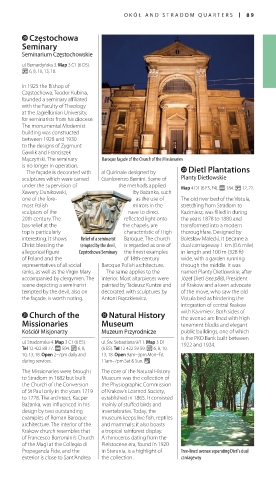
Mączyński. The seminary Baroque façade of the Church of the Missionaries
is no longer in operation. dDietl Plantations
The façade is decorated with al Quirinale designed by
sculptures which were carved Gianlorenzo Bernini. Some of Planty Dietlowskie
under the supervision of the methods applied Map 4 D1 (6 E5, F4). @ 184. v 12, 22.
Xawery Dunikowski, by Bażanka, such
one of the fore as the use of The old river bed of the Vistula,
most Polish mirrors in the stretching from Stradom to
sculptors of the nave to direct Kazimierz, was filled in during
20th century. The reflected light onto the years 1878 to 1880 and
basrelief at the the chapels, are transformed into a modern
top is particularly characteristic of High thoroughfare. Designed by
interesting. It shows Relief of a seminarist Baroque. The church Bolesław Malecki, it became a
Christ blessing the tempted by the devil, is regarded as one of dual carriageway 1 km (0.6 mile)
allegorical figure Częstochowa Seminary the finest examples in length and 100 m (328 ft)
of Poland and the of 18thcentury wide, with a garden running
representatives of all social Baroque Polish architecture. through the middle. It was
ranks, as well as the Virgin Mary The same applies to the named Planty Dietlowskie, after
accompanied by clergymen. The interior. Most altarpieces were Józef Dietl (see p88), President
scene depicting a seminarist painted by Tadeusz Kuntze and of Krakow and a keen advocate
tempted by the devil, also on decorated with sculptures by of the move, who saw the old
the façade, is worth noting. Antoni Frączkiewicz. Vistula bed as hindering the
integration of central Krakow
aChurch of the sNatural History with Kazimierz. Both sides of
the avenue are lined with high
Missionaries Museum tenement blocks and elegant
Kościół Misjonarzy Muzeum Przyrodnicze public buildings, one of which
is the PKO Bank built between
ul. Stradomska 4. Map 3 C1 (6 E5). ul. Św. Sebastiana 9/11. Map 3 D1 1922 and 1924.
Tel 12 422 88 77. @ 504. v 6, 8, (6 E5). Tel 12 422 59 59. v 6, 8, 10,
10, 13, 18. Open 2–7pm daily and 13, 18. Open 9am–3pm Mon–Fri,
during services. 11am–7pm Sat & Sun. &
The Missionaries were brought The core of the Natural History
to Stradom in 1682 but built Museum was the collection of
the Church of the Conversion the Physiographic Commission
of St Paul only in the years 1719 of Krakow’s Learned Society,
to 1728. The architect, Kacper established in 1865. It consisted
Bażanka, was influenced in his mainly of stuffed birds and
design by two outstanding invertebrates. Today, the
examples of Roman Baroque museum keeps live fish, reptiles
architecture. The interior of the and mammals; it also boasts
Krakow church resembles that a tropical rainforest display.
of Francesco Borromini’s Church A rhinoceros dating from the
of the Magi at the Collegio di Pleistocene era, found in 1920
Propaganda Fide, and the in Starunia, is a highlight of Tree-lined avenue separating Dietl’s dual
exterior is close to Sant’Andrea the collection. carriageway

