


Page 26 - (DK Eyewitness) Travel Guide - Tokyo
P. 26
24 INTRODUCING T OK Y O
Court Life and the Tale of Genji armies of warrior-monks.
Ironically, Buddhism’s
Court life in the Heian period focused on romance, aesthetic
pursuits, and fastidious observation of precedent and ritual, as abhorrence of killing fed the
docu mented in the Pillow Book nobility’s contempt for the
of court lady Sei Shonagon in the farmer-warriors – the early
late 10th century. The Tale of Genji,
written in the early 11th century samurai – on the frontier,
by Sei Shona gon’s rival, Murasaki who bat tled the indigenous
Shi kibu, a court lady of the Fujiwara people and each other. After
clan, is possibly the world’s oldest
novel. It depicts the loves and 1100, the court could no
sor rows of a fictitious prince, Genji, longer control infighting,
and, after he dies, the amorous
pur suits of a man whom Genji and tensions rose between
thought was his son. The story has two clans of farmer-warriors
been illustrated in countless scrolls.
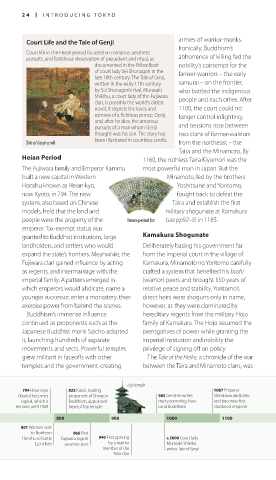
Tale of Genji scroll from the northeast – the
Taira and the Minamoto. By
Heian Period 1160, the ruthless Taira Kiyomori was the
The Fujiwara family and Emperor Kammu most powerful man in Japan. But the
built a new capital in Western Minamoto, led by the brothers
Honshu known as Heian-kyo, Yoshit sune and Yoritomo,
now Kyoto, in 794. The new fought back to defeat the
system, also based on Chinese Taira and establish the first
models, held that the land and military shogun ate at Kamakura
people were the property of the Heian-period fan (see pp92–5) in 1185.
emperor. Tax-exempt status was
granted to Buddhist institutions, large Kamakura Shogunate
landholders, and settlers who would Deliberately basing his government far
expand the state’s frontiers. Meanwhile, the from the imperial court in the village of
Fujiwara clan gained influence by acting Kamakura, Minamoto no Yoritomo carefully
as regents, and intermarriage with the crafted a system that bene fited his bushi
imperial family. A pattern emerged in (warrior) peers and brought 150 years of
which emperors would abdicate, name a relative peace and stability. Yoritomo’s
younger successor, enter a monastery, then direct heirs were shoguns only in name,
exercise power from behind the scenes. however, as they were dominated by
Buddhism’s immense influence hereditary re gents from the military Hojo
continued as proponents such as the family of Kamakura. The Hojo assumed the
Japanese Buddhist monk Saicho adapt ed preroga tives of power while granting the
it, launching hundreds of separate imperial institution and nobility the
movements and sects. Powerful tem ples privilege of signing off on policy.
grew militant in faceoffs with other The Tale of the Heike, a chronicle of the war
temples and the government, creating between the Taira and Minamoto clans, was
Toji temple
794 Heian-kyo 823 Kukai, leading 1087 Emperor
(Kyoto) becomes proponent of Shingon 985 Genshin writes Shirakawa abdicates
capital, which it Buddhism, appointed tract promoting Pure- and becomes first
remains until 1868 head of Toji temple Land Buddhism cloistered emperor
800 900 1000 1100
801 Warriors sent
to Northern 866 First
Honshu to battle Fujiwara regent 940 First uprising c.1000 Court lady
Ezo tribes assumes post by a warrior Murasaki Shikibu
member of the writes Tale of Genji
Taira clan
024-025_EW_Tokyo.indd 24 12/09/16 11:27 am

