


Page 57 - (DK Eyewitness) Travel Guide - Tokyo
P. 57
T OK Y O NA TIONAL MUSEUM 55
Tokyo National Museum: Heiseikan
Built in 1993 to commemorate the Crown Prince’s
wedding, the Heiseikan houses major temporary
exhibitions and a superb collection of Japanese
archaeological artifacts. Its modern facilities do
full justice to the fascinating displays. The Japan ese
archaeology gallery, with items from 10,000–7,000 BC
onward, is located on the first floor. The
temporary exhibitions on the second
floor are of mainly – but not only –
Japanese art. Captions are in English
and Japanese.
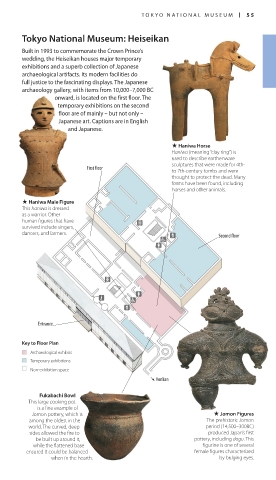
. Haniwa Horse
Haniwa (meaning “clay ring”) is
used to describe earthenware
sculptures that were made for 4th-
First floor
to 7th-century tombs and were
thought to protect the dead. Many
forms have been found, including
horses and other animals.
. Haniwa Male Figure
This haniwa is dressed
as a warrior. Other
human figures that have
survived include singers,
dancers, and farmers. Second floor
Entrance
Key to Floor Plan
Archaeological exhibits
Temporary exhibitions
Non-exhibition space
Honkan
Fukabachi Bowl
This large cooking pot
is a fine example of
Jomon pottery, which is . Jomon Figures
among the oldest in the The prehistoric Jomon
world. The curved, deep period (14,500–300BC)
sides allowed the fire to produced Japan’s first
be built up around it, pottery, including dogu. This
while the flattened base figurine is one of several
ensured it could be balanced female figures characterized
when in the hearth. by bulging eyes.
054-055_EW_Tokyo.indd 55 12/09/16 11:23 am

