


Page 59 - (DK Eyewitness) Travel Guide - Tokyo
P. 59
NOR THERN T OK Y O 57
The Floating World of Ukiyo-e
In the Edo period, wood-block prints, called ukiyo-e, or pictures of the pleasure-seeking
“floating world,” became the most popular pictorial art of Japan. They had a profound
influence on artists such as Matisse and Van Gogh. Although today they are credited
to individual artists, they were in fact a cooperative effort between the publisher,
responsible for financing and distributing the work; the artist, who produced a fine
line drawing; the carver, who pasted the drawings onto blocks of wood and carved
away what was not to appear on the print, making one block for each color; and the
printer, who inked the wooden blocks and pressed them onto the paper – one for
each color, starting with the lightest. Editions were limited to 100–200 copies. The
first artist known by name was Moronobu, who died in 1694. The golden age of
ukiyo-e lasted from about 1790 to the 1850s. Beautiful women, Kabuki actors, scenes
from Tokyo, including Shitamachi, and the supernatural were recurring themes.
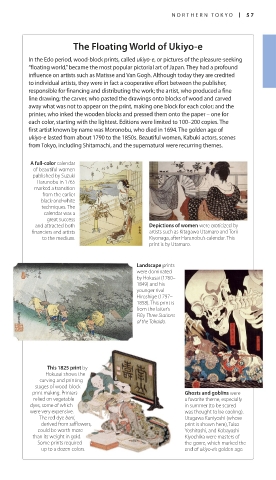
A full-color calen dar
of beautiful women
published by Suzuki
Harunobu in 1765
marked a transition
from the earlier
black-and-white
techniques. The
calendar was a
great success
and attracted both Depictions of women were eroticized by
financiers and artists artists such as Kitagawa Utamaro and Torii
to the medium. Kiyonaga, after Harunobu’s calendar. This
print is by Utamaro.
Landscape prints
were dominated
by Hokusai (1760–
1849) and his
younger rival
Hiroshige (1797–
1858). This print is
from the latter’s
Fifty-Three Stations
of the Tokaido.
This 1825 print by
Hokusai shows the
carving and printing
stages of wood-block
print making. Printers Ghosts and goblins were
relied on vegetable a favorite theme, especially
dyes, some of which in summer (to be scared
were very expensive. was thought to be cooling).
The red dye beni, Utagawa Kuniyoshi (whose
derived from safflowers, print is shown here), Taiso
could be worth more Yoshitoshi, and Kobayashi
than its weight in gold. Kiyochika were masters of
Some prints required the genre, which marked the
up to a dozen colors. end of ukiyo-e’s golden age.
056-057_EW_Tokyo.indd 57 12/09/16 11:42 am

